

I love my Tesla Model Y.
And apparently a lot of my readers do too. Like Bruce C. who messaged me: “I own a 2026 Tesla Model Y. I LOVE IT! Every owner that I’ve talked to absolutely LOVES their Tesla.”
There’s just one thing I wish I could change about owning an electric vehicle (EV).
Charging.
If you’re driving around town and can plug in at home every night, charging isn’t usually much of an issue.
But what happens when you want to take a long road trip?
You have to think about how far your battery will take you, where you’ll stop to recharge and how long you’ll have to wait before getting back on the road.
And if you’re driving an electric truck carrying thousands of pounds of cargo across the country, those problems compound exponentially.
I always thought it would be amazing if you could charge your electric vehicle without ever having to stop driving.
And today, Honda is developing a technology that could make this dream possible.
The Road Charger
Last month, Honda announced it’s developing a technology that could fundamentally change how electric vehicles get their power.
And it’s based on something we use every day.
The roads we drive on.
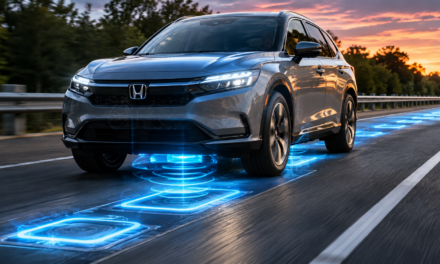
Working with Japanese construction companies Taisei and Taisei Rotec, Honda has developed a system that can wirelessly transfer electricity from equipment buried beneath the pavement to vehicles driving overhead.
The technology uses electromagnetic induction, the same basic principle behind the wireless charging pads you can use for your smartphone.
Coils embedded in the pavement create a magnetic field that transfers electricity to a receiver mounted underneath a vehicle.

And the vehicle doesn’t have to stop for any of this to happen. It can keep driving while its battery receives electricity.
Honda plans to begin testing the technology on a public highway during Japan’s fiscal year 2027. The company wants to demonstrate that it can deliver up to 150 kilowatts of power to moving vehicles.
That’s roughly as much power as you can get from a typical highway fast-charging station, without ever having to stop to use it.
But this technology isn’t unique. Engineers around the world have already demonstrated that charging vehicles while they drive is possible.
And some of the most impressive work is happening right here in America.
Earlier this year, researchers at Purdue University revealed they’d successfully charged an electric semi-truck while it was traveling down a public highway at 65 miles per hour.
Working with the Indiana Department of Transportation and commercial vehicle manufacturer Cummins, the researchers installed wireless charging equipment beneath a quarter-mile stretch of highway in West Lafayette, Indiana.

Image: Purdue University/Photo by Kelsey Lefever
As the specially equipped truck drove over the pavement, the system transferred electricity directly to its battery.
And we’re not talking about a mere trickle of power.
It delivered between 50 and 190 kilowatts of electricity while the truck was moving, with power-transfer efficiency approaching 85%. In other words, it received enough electricity to significantly extend its driving range, with very little energy lost in the process.
Other entities are also working on this technology.
In Detroit, Israeli technology company Electreon helped build America’s first public wireless charging roadway in 2023. The quarter-mile installation uses coils embedded beneath the pavement to charge specially equipped vehicles as they drive over it.
Meanwhile, Florida is developing a three-quarter-mile wireless charging section of State Road 516, a new highway being built near Orlando. That project is designed to deliver up to 200 kilowatts of power to compatible vehicles, roughly as much as a powerful public fast-charging station.
And overseas, a company called Electreon has already demonstrated even greater charging power on France’s A10 motorway. During testing, its system delivered more than 200 kilowatts on average to a heavy-duty truck, with peak power exceeding 300 kilowatts.
Of course, these are still small-scale tests. But they prove that the technology can work on real roads.
Even the federal government is getting involved.
The Federal Highway Administration (FHWA) is supporting research into wireless charging roads, including the project in Indiana.
But the reality is that installing charging equipment beneath existing highways is expensive. One Indiana feasibility study estimated that a wireless charging lane could cost more than $6 million per mile.
Still, there may be a practical way to introduce the technology without rebuilding the entire highway system.
And it starts with America’s trucking industry.
Electric semi-trucks need enormous batteries to haul heavy loads over long distances. These batteries are expensive, heavy and take up valuable space.
But if trucks could recharge while driving, they wouldn’t need nearly as much battery power onboard.

That could mean smaller, lighter and cheaper batteries, more room for cargo and a much more practical way to power long-distance trucking.
Commercial trucking could also make the technology more affordable to roll out.
Unlike passenger vehicles, which travel all over the place, commercial trucks often follow the same shipping routes. That means we wouldn’t need to electrify every highway.
We could simply start with the busy trucking routes where thousands of vehicles travel the same roads every day.
Here’s My Take
What excites me the most about Honda’s announcement is that it offers a potential solution to one of the biggest headaches of owning an electric vehicle.
Instead of building bigger batteries or faster charging stations, we could make charging part of the driving experience.
It’s the kind of breakthrough that could give the EV market a much-needed jolt.
Regards,

Ian King
Chief Strategist, Banyan Hill Publishing
Editor’s Note: We’d love to hear from you!
If you want to share your thoughts or suggestions about the Daily Disruptor, or if there are any specific topics you’d like us to cover, just send an email to dailydisruptor@banyanhill.com.
Don’t worry, we won’t reveal your full name in the event we publish a response. So feel free to comment away!