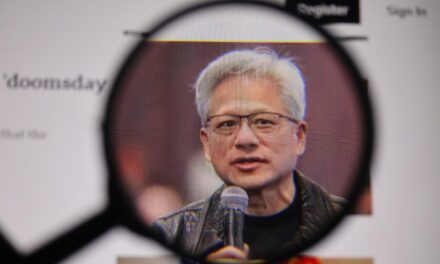

Jensen Huang’s sudden resignation as Nvidia CEO could have consequences far beyond the company he spent more than three decades building.
Nvidia has become one of the driving forces behind America’s AI boom. And his sudden departure raises serious questions about the industry’s future.
But there’s another part of this story that concerns me even more.
It appears that Huang had a relationship with a Chinese businesswoman whom U.S. intelligence officials suspect of working for Beijing.
And what investigators are uncovering about the woman’s business dealings raises serious questions about America’s ability to protect its technology.
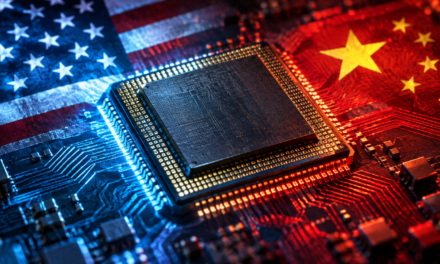
Alice Huang reportedly helped facilitate the shipment of $7.5 billion worth of Nvidia’s advanced AI chips to Chinese companies, potentially circumventing U.S. export restrictions designed to keep them out of China’s hands.
If these allegations prove true, they could expose a serious weakness in America’s efforts to maintain its AI advantage.
China’s AI Shortcut
For years now, the U.S. has tried to prevent China from getting its hands on our most advanced AI chips.
And for good reason.
Companies like OpenAI, Anthropic and Google depend on thousands of powerful processors to train their AI models. Nvidia’s H100 and H200 chips are especially valuable because they can handle the enormous calculations required to develop advanced AI.
That’s why Washington has restricted their export to China.
But according to an investigation by The Information, Alice Huang allegedly helped arrange shipments of approximately 240,000 Nvidia processors to Chinese companies.
The operation reportedly involved a network of businesses in Singapore and China, including Megaspeed, a Singapore-based AI data center company formerly run by Alice Huang. Together, they allegedly helped move roughly $7.5 billion worth of Nvidia’s H100, H200 and older A100 processors into China.

And all of this was supposedly happening while Washington was trying to keep those very same chips out of China’s hands.
Megaspeed denies any wrongdoing and has hired outside lawyers to investigate the allegations. And there’s no public evidence that Jensen Huang knowingly helped Chinese intelligence or approved any illegal shipments.
Nvidia has also said it has no reason to believe its secrets or national security were compromised.
But the alleged operation exposes a problem Washington has struggled with for years.
Nvidia sells its chips worldwide. But once they pass through several companies and countries, tracking where they end up is extremely difficult.
And that’s especially troubling because China is already finding other ways to catch up with America’s AI industry.
Back in July, I told you how Chinese companies were developing AI models that rivaled America’s best systems at a fraction of the cost.
DeepSeek and Moonshot AI released models that offer competitive performance at a much lower price than American alternatives.
Other Chinese AI developers have also been accused of using American models to accelerate their own progress.
Anthropic reported that developers in China created roughly 24,000 accounts to access its Claude chatbot, generating more than 16 million conversations.
The company believes those interactions were used to train competing systems through a technique called distillation. Put simply, it’s when one AI model teaches another by providing examples of how to answer questions and solve problems.
Distillation can reduce the time and money needed to develop competitive AI.
Now consider what happens if those same companies can also get their hands on Nvidia’s most advanced chips. They’d have access to both the computing power and the techniques that could help them close the gap with American AI companies even faster.
But getting hold of our AI chips is only part of the threat.
What if China also gets the technology needed to manufacture these advanced chips itself?
For example, Dutch company ASML makes machines that use a process called extreme ultraviolet (EUV) lithography to print incredibly tiny circuits onto silicon chips.

These machines rely on extraordinarily precise mirrors to direct light, and they’re essential for making many of today’s most powerful processors.
But China has been restricted from buying these machines.
If China develops or acquires comparable technology, it could eventually produce more of its own advanced AI chips instead of relying on American suppliers.
And that would make our export restrictions far less effective.
Fortunately, Washington is starting to treat AI infrastructure as a national security priority.
I’ve explained how the government is working with private companies to expand America’s AI infrastructure, even as communities push back against new data centers. And lawmakers from both parties are now calling for tighter restrictions on advanced chip exports to China.
But building more infrastructure here at home won’t be enough if we can’t protect the technology behind it.
Here’s My Take
America has the world’s leading AI chip designers, some of the most advanced AI models and enormous amounts of private capital being invested in this technology.
But China is a formidable competitor. And it’s finding ways to close the gap with America’s leading AI companies without matching their enormous spending.
The allegations surrounding Nvidia show why restricting chip exports alone might not be enough to preserve our lead.
I expect it means we’ll see greater investment in technologies that track advanced hardware, secure AI systems and protect valuable intellectual property.
And that should create some exciting opportunities for investors.
But this scandal also shows how difficult the race to artificial superintelligence could become.
I believe America’s ability to stay ahead will depend on more than how quickly our companies innovate.
We’ll also need to make sure the enormous investments we’re making today will give us an advantage that lasts.
Regards,

Ian King
Chief Strategist, Banyan Hill Publishing
Editor’s Note: We’d love to hear from you!
If you want to share your thoughts or suggestions about the Daily Disruptor, or if there are any specific topics you’d like us to cover, just send an email to dailydisruptor@banyanhill.com.
Don’t worry, we won’t reveal your full name in the event we publish a response. So feel free to comment away!