

There’s a lot more to trading than winning and losing.
There are bad wins and good losses. But the only way to know the difference is through experience and preparation.
And THAT means knowing when to optimize your process.
Lately, markets are down and the plays are choppy. I’m taking single and double-digit profits.
Consistently taking singles and doubles is what builds long-term success. You don’t have to swing for the fences on every trade.
That said, I’ll never complain about making $7,230 in a week. Especially since I donate 100% of my trading profits to charity.
More important than the money, there are two very important lessons…
• First, small gains add up. A lot of new traders see screenshots on social media and think trading is about how much you can make from one trade. It’s not. Consistency and risk management are MUCH more important than big wins.
• Second, protecting gains is ALWAYS better than holding and hoping. Over and over again, I take small gains when a stock doesn’t do what I thought it would do. I’m OK with that because I’ve learned when to optimize. And that helps me maximize the lessons from every trade.
Keep reading for more about the best time to optimize your process.
When to Optimize Your Process
For years, I studied and prepared.
And to this day, I make watchlists, scan news, write Tim Sykes Daily, make video lessons and review my trades.
All those things are an extension of the time put into studying early in my career.
The reason I often say preparation is key is because … IT IS.
Nothing has changed fundamentally from my early days as a trader. Yes, we have better tools.
And there are a LOT more traders thanks to the internet and all the trading platforms.
But the reasons why stocks spike (and crash) haven’t changed much. The same patterns keep playing out again and again.
I’ve always looked forward to the market opening on Monday mornings. With rare exceptions, I’m ready and waiting when the market opens every day.
But it’s preparation when the market isn’t open that makes the open market profitable.
Yes, you need screen time. But you also need to know what you’re watching.
So use the time when the market isn’t open to optimize your process. Come to the market ready every day.
Trading Mentor: YOUR Questions
I love hearing from you and all my students. I read all your emails. So I want to take time today to answer some of your questions…
“What news is a good catalyst these days for small caps?”
This is like asking what I think the market will do. Or what will happen with an individual stock.
You need to stop trying to predict.
What kind of news catalyst is good? Let the market decide.
Look at the news of all the biggest percent gainers. What did the market decide was the best news?
The market has all the data you need. You just have to look.
Who cares what I think? What if I say some news is good? My opinion is worth nothing. Nothing.
Listen to what the market says about the news that matters.
If three of the top five percent winners are crypto stocks with crypto news, then crypto news matters.
Why? Because the market says so. It doesn’t matter what I say.
The market doesn’t care what you want or what I think. Learn to react.
You want simple answers, but that won’t make you a great trader.
All my top students have the right mindset. They’re thinking the right way. They’re learning the right way and putting lessons into practice.
Do you really want this? Then be a good student. Study like you’ve never studied before.
Next question…
“I see OTCs pop in minutes on breaking news and tweets. Would you say the update in technology has closed the ‘informational inefficiency’ gap?”
Not at all.
Sometimes breaking news plays spike in a few seconds or a few minutes.
But often the biggest gains happen overnight and on day two — after the news. So informational inefficiency still exists.
How you play it is another thing altogether.
I often underestimate how far a stock can run. But I trade small to teach.
And I’m impatient. I’d rather lock in a single than try to predict how far a stock will go.
Let’s look at a trade…
This trade goes well with the questions.
Again, let the market decide what news is important. Sometimes it’s not a traditional news catalyst that spikes a stock. Your goal is to learn to react.
Southcorp Capital Inc. (STHC) had the Dark or Defunct designation on OTC Markets.
However, the company announced a change of control…
The new CEO said, “The focus and strategy going forward in the coming months will be to bring the status of the company current with OTC Markets, and to complete a reverse takeover (RTO) with AMECA Mining. We have many exciting announcements to make once we complete the transaction with AMECA.”
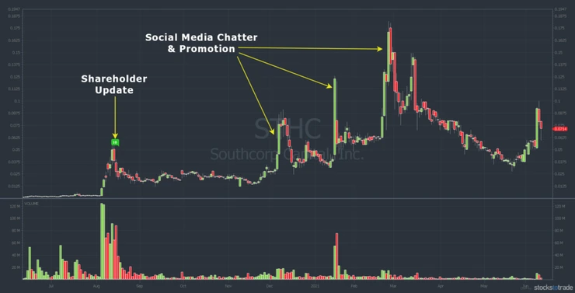
Then, the stock has spiked more than once with social media hype and promotion. Here’s the STHC one-year chart…
Source: Stocks To Trade
STHC chart: 1-year, daily candle, merger news/chatter.
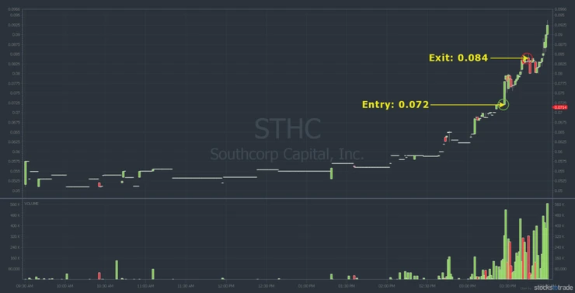
STHC had another big spike with more Twitter hype about the upcoming merger…
Source: Stocks To Trade
STHC chart: Late-day runner on Twitter hype
This was a speculative trade based on momentum and Twitter hype.
My goal was really just to see how far it could go. I didn’t plan to hold it overnight. Anything between 10%–30% on this trade would’ve met my goals.
It turned out to be a 16.67% win for $1,133 in profits.
Of course, past performance doesn’t indicate future results. But it was a solid trade based on what the stock was actually doing.
You can find dozens of “know what you own” tweets with all sorts of due diligence links about stocks.
Are they accurate? I don’t know. Frankly, I don’t care. Most penny stock companies fail.
Don’t get me wrong, I don’t want them to fail. But I always expect the worst. And I’m happy to lock in singles along the way.
Trading conservatively has kept me in the game for two decades.
The Time to Start is NOW
Remember, most traders, 90% or more, lose money. Why? Because they fail to prepare.
So if you want to be different, learn to maximize the hours when the market is closed.
That’s when to optimize your process.
It means studying on weekends and evenings. And it might mean getting up early to put in the time before you go to work.
Whatever it takes, use market downtime to grow your knowledge account and optimize. Most people won’t.
Will you?
How do YOU optimize your process when the market isn’t open? Let me know at SykesDaily@BanyanHill.com. I love to hear from ALL my readers!
Cheers,

Tim Sykes
Editor, Tim Sykes Daily