

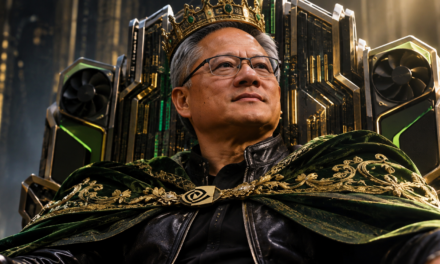
I have to admit, I didn’t see this coming. Certainly not this soon.
In fact, after everything we learned about the scandal surrounding Nvidia CEO Jensen Huang, I thought his days running the world’s most important AI chip company might truly be over.
But apparently Nvidia’s board had other ideas.
On Monday, the company announced that Huang was returning as CEO, just days after forcing him out.

And investors loved the news. Nvidia’s stock finished the day up over 31%, adding nearly $1 trillion to the company’s market value and helping fuel a massive rally across Wall Street.
But the scandal surrounding Huang is far from over.
The New York Times recently reported that the woman it revolves around had been in contact with an official from China’s top intelligence agency for more than a year.
And those communications took place while she and Huang were having an affair.
That leaves me wondering what the return of the king of the AI boom means for Nvidia, its investors and the future of AI.
Why Nvidia Wanted Jensen Back
During Nvidia’s quarterly earnings call last Tuesday, board chairman Harvey Jones told investors that Huang would not be returning as CEO.
The company had already begun looking for his replacement, with longtime chief financial officer Colette Kress serving as interim CEO.
But less than a week later, the board voted unanimously to bring Huang back.
According to Nvidia’s announcement, the directors met with Huang several times and came away satisfied with his honesty and ability to lead the company. They also consulted senior officials in the U.S. government before concluding that his return posed no national security risk.
I understand why Nvidia made this move.
Because Jensen Huang is almost impossible to replace.

Image: Nvidia
And I’m not just talking about his technical knowledge.
Huang has been the public face of Nvidia throughout the AI boom. He’s the person investors look to when they want to know where the industry is headed.
Huang co-founded Nvidia in 1993, when the company was developing graphics chips for video games. Over the next three decades, he turned it into the world’s leading supplier of chips used to develop artificial intelligence.
Today, tech giants like Microsoft, Amazon, Google and Meta rely on Nvidia’s chips to power their AI systems. And Huang has spent decades cultivating relationships with both his biggest customers and the companies that manufacture Nvidia’s chips.
So finding someone to fill Huang’s shoes would be difficult enough. But trying to do it in the middle of a scandal, with investors already nervous about the AI boom, would be an enormous gamble.
And investors weren’t the only ones who wanted him back.
Over the past two weeks, Nvidia employees, shareholders and some of Silicon Valley’s biggest names had been calling for Huang’s return.
Even President Trump publicly expressed support for bringing him back.

According to The Wall Street Journal, Trump believed restoring Huang to his position was critical to restoring confidence in the AI boom.
Of course, just because Nvidia reinstated Huang doesn’t mean that it can put the scandal to bed.
The company says its independent investigation into the suspected foreign intelligence operation will continue. It has also established a new committee to oversee national security and export controls.
And Nvidia plans to hire a chief compliance officer to help make sure the company follows the rules.
As I explained in recent articles, investigators have been examining whether advanced Nvidia chips were illegally diverted to China through overseas companies.
One of the companies under investigation is Megaspeed, where Alice Huang previously worked as an executive, the woman Jensen was having an affair with.
Washington has restricted sales of America’s most advanced AI chips to China because those processors can be used to develop powerful AI systems, including technology with military applications.

But companies like Megaspeed operate data centers that allow customers to rent computing power rather than purchase their own chips.
So even if Chinese companies can’t legally buy Nvidia’s most advanced chips, they may still be able to use them without ever bringing them into China.
What investigators want to know is whether Megaspeed went a step further and helped get restricted Nvidia chips into China.
So far, the Department of Justice (DOJ) has said it has no evidence of wrongdoing by Nvidia or Jensen Huang.
And after consulting with U.S. government officials, Nvidia’s board clearly felt comfortable enough to put Huang back in charge while the investigation continues.
Judging by Monday’s rally, investors are comfortable with that decision, too.
But with federal investigators and Congress still asking questions, Huang’s biggest challenge may be convincing Washington that Nvidia can be trusted with America’s most advanced technology.
Here’s My Take
Bringing Jensen Huang back was the right move for Nvidia.
But there are still serious questions about what happened, how much sensitive technology may have reached China and whether Nvidia can prevent something like this from happening again.
And I suspect we’ll be hearing a lot more about those questions in the weeks ahead.
Which brings me back to the title of today’s article.
Tolkien’s The Return of the King brought The Lord of the Rings trilogy to a close. And Peter Jackson’s movie did the same for the film series.
But I have a feeling that Jensen Huang’s return isn’t the end of this story.
And I’m sure there are plenty of chapters left in the Nvidia saga.
Regards,

Ian King
Chief Strategist, Banyan Hill Publishing
Editor’s Note: We’d love to hear from you!
If you want to share your thoughts or suggestions about the Daily Disruptor, or if there are any specific topics you’d like us to cover, just send an email to dailydisruptor@banyanhill.com.
Don’t worry, we won’t reveal your full name in the event we publish a response. So feel free to comment away!