

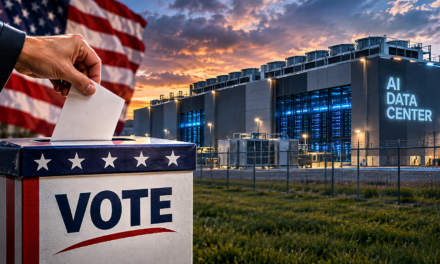
On Tuesday, American voters delivered a stunning message to Washington.
Democrats swept into control of both houses of Congress, handing President Trump and the Republican Party a major defeat.
But something else happened on Election Day that could have enormous consequences for the technology industry.
Across the country, voters rejected plans to build new AI data centers in their communities. And in several states at the center of America’s AI boom, candidates promising tougher restrictions on these facilities won important elections.
Big Tech has been spending hundreds of billions of dollars building the infrastructure needed to power artificial intelligence.
Now, some of those projects could face delays, new regulations and growing public opposition.
And I believe Tuesday’s results could change where some of the biggest investment opportunities in AI emerge over the next few years.
America’s AI Backlash
On Tuesday, voters in 10 states weighed in on 41 local ballot measures involving data centers.
And they made their feelings clear.
By Wednesday evening, 39 of those votes had been counted. In 38 of them, voters either approved restrictions on new data centers or rejected proposals that would have made them easier to build.
Ohio led the way with 21 measures, but the opposition stretched across the country, from small towns to some of America’s biggest technology hubs.
And those results shouldn’t come as a surprise.
A September poll from the University of Massachusetts Amherst found that 65% of Americans oppose building an AI data center in their community. Just 11% support it.

Image: University of Massachusetts Amherst
It also wasn’t limited to local ballot measures.
In Texas, Democrat Gina Hinojosa defeated Republican Gov. Greg Abbott after promising to halt new data-center construction until the state establishes stronger protections for residents.
Texas is one of the biggest states for new data-center construction. In fact, it’s expected to account for nearly 30% of all new U.S. data-center capacity in 2028, according to SemiAnalysis.
And Texas isn’t alone. Georgia and Ohio also elected governors who favor tighter restrictions on data centers.
But why are so many Americans pushing back against an industry that’s supposed to help drive our economy?
A big part of the answer comes down to electricity, something I’ve been hammering on here in the Daily Disruptor all year.
According to the International Energy Agency, electricity used by data centers worldwide could 3X by 2035.
Electricity consumption by data centres, 2020-2035

Image: IEA (2026)
That means power companies will need to build new generating plants, transmission lines and other infrastructure to keep up.
But ordinary customers could end up paying higher electric bills to help support facilities owned by some of the wealthiest companies in the world.
And electricity is only part of the problem.
Data centers also need cooling systems to keep their computer chips from overheating. And some use enormous amounts of water to do it.
They also create relatively few permanent jobs once construction is finished. So it’s no surprise that residents are asking what they’re getting in return.
Tuesday’s results show they want more say in what gets built in their communities. And Big Tech will have to listen.
Consider what’s happening in Texas.
Hinojosa has called for pausing new data-center construction until lawmakers address concerns about electricity, water and property rights. She also wants to eliminate tax breaks for large data centers and make sure the companies building them pay for the electricity and water infrastructure they need.
But there’s already evidence that some newly elected officials are willing to negotiate.
On Wednesday, Meta President Dina Powell McCormick revealed that a governor-elect who campaigned on restricting data centers had already asked to meet after taking office, saying the state didn’t want to lose the investment and jobs.
That’s a reminder that states pushing for tougher rules also risk losing billions in investment to places that are more welcoming.
But companies planning new projects could face expensive delays.
If a company can’t secure enough electricity or get permission to build a new data center, it may have to postpone plans to expand its computing capacity. And in an industry where companies are competing to develop better AI models as fast as possible, time is incredibly valuable.

The election also changes the political picture in Washington.
With Democrats taking control of both houses of Congress in January, Big Tech could face a lot more scrutiny in Washington. Lawmakers could start asking tougher questions about how AI companies protect consumers, handle personal information and keep their increasingly powerful systems under control.
Of course, Congress won’t be able to pass whatever new AI regulations it wants.
President Trump will remain in the White House, and he can veto any legislation he opposes. So there’s no guarantee that new federal AI laws will pass.
But congressional committees can still investigate companies, demand information and hold public hearings. And state and local governments have their own powers to regulate construction, land use and utilities.
That means Big Tech could face pressure from several directions at once.
Here’s My Take
Shares of several AI infrastructure companies have fallen this week over concerns about tougher regulations and construction delays.
But I think some of Big Tech’s biggest players could actually benefit.
Amazon (Nasdaq: AMZN), Alphabet (Nasdaq: GOOGL), Meta Platforms (Nasdaq: META) and SpaceX (Nasdaq: SPCX) have already invested billions in data centers. And if new facilities become harder to build, the computing power they already own could become a lot more valuable.
For example, SpaceX already rents computing power to Anthropic in a deal worth as much as $15 billion a year.
These companies could also end up spending less on new construction, leaving them with more cash.
And I also see opportunities for companies developing more efficient chips, better cooling systems and ways to generate electricity on-site.
Because no matter what happens with new construction, demand for AI isn’t going away.
That means the companies that already have the computing power to meet this demand could be sitting on a gold mine.
Regards,

Ian King
Chief Strategist, Banyan Hill Publishing
Editor’s Note: We’d love to hear from you!
If you want to share your thoughts or suggestions about the Daily Disruptor, or if there are any specific topics you’d like us to cover, just send an email to dailydisruptor@banyanhill.com.
Don’t worry, we won’t reveal your full name in the event we publish a response. So feel free to comment away!