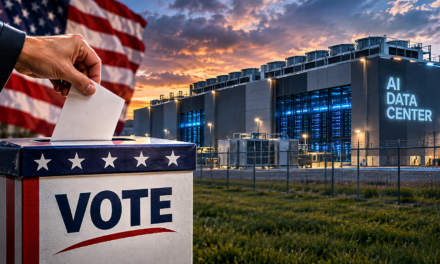


Last week’s midterm elections delivered a stern warning to Big Tech.
Across the country, voters pushed back against new AI data centers, threatening an industry already spending hundreds of billions of dollars on infrastructure.
Does it mean the AI bubble is about to pop?
I’m on record that the AI revolution is just getting started. But what if we discover that we don’t need nearly as many data centers as everyone expects?
That might seem unlikely, especially since demand for AI computing power continues to soar.
But Microsoft and Nvidia just unveiled a new generation of computers that could fundamentally change how artificial intelligence works.
And I believe they’ve just exposed a weakness that could put billions of dollars in AI investments at risk.
The AI Revolution Gets Personal
Last month, Nvidia announced a new generation of Windows computers developed with Microsoft and several major PC manufacturers.
These aren’t ordinary PCs.
Powered by Nvidia’s RTX Spark technology, they can deliver up to one petaflop of AI performance, with enough memory to run sophisticated AI models directly on the computer.

Image: Nvidia
That means they can handle tasks that previously required powerful servers in distant data centers.
Think about how you use ChatGPT today.
When you ask a question, your request goes to a data center, where expensive chips process it and send back an answer.
But what if your computer could do a lot of that work on its own?
For example, you could ask an AI assistant to summarize documents, analyze information or write software without constantly relying on the cloud. But more complicated tasks could still be handled by remote servers.
That’s the idea behind Microsoft’s approach to combining local and cloud-based AI.
As this technology gets cheaper, powerful AI could eventually run on millions of everyday computers. And it could have enormous implications for the data center industry.
As I explained last month, AI is using more computing power to run models instead of training them.
That’s called inference. And according to Deloitte, it accounted for roughly one-third of AI computing in 2023.
This year, inference is expected to account for about two-thirds.

But what if more of that work could be done on your own computer instead?
Suddenly, the economics of the entire AI infrastructure buildout could look very different.
Of course, data centers wouldn’t disappear. After all, it takes an enormous amount of computing resources to train advanced models and run sophisticated AI applications.
What’s more, the Jevons Paradox tells us that making AI cheaper could also encourage people to use far more of it.
But even if AI usage keeps growing, companies might not spend nearly as much on cloud computing as Wall Street expects. And that could become a serious problem for companies borrowing heavily to finance this expansion.
Venture capitalist Paul Kedrosky recently raised a similar concern on The Ezra Klein Show.

Image: LinkedIn
He pointed out that major infrastructure booms have a troubling history of excessive borrowing, inflated asset prices and oversupply.
During America’s railroad boom, investors built more tracks than the market could support. Railroads transformed the country, but many of the companies financing their expansion failed.
Kedrosky worries something similar could happen with AI.
I warned you about the same thing back in January, when I noted that this set-up looks eerily like the massive overbuilding that preceded the dot-com crash.
Today, roughly one-third of AI infrastructure spending is now being financed through debt. And if data center revenue falls short of expectations, operators could struggle to repay their loans, forcing lenders to pull back and projects to be canceled.
Elon Musk believes this process is already starting.
Recently, he warned that debt markets have become much less willing to finance companies that depend almost entirely on AI data centers for revenue. He also predicted that many of the industry’s 200-plus specialized AI cloud providers could fail or be forced to merge.

And we’re already seeing signs of pressure building.
Reuters recently reported that the yield on some bonds issued by CoreWeave, a major AI cloud provider, had climbed above 15%. That’s an expensive way to finance an industry that needs billions of dollars to keep growing.
As Kedrosky warned, the AI boom is now tied to private credit funds, insurance companies and ordinary investment portfolios.
Last Thursday, we got a painful reminder of just how much is riding on this boom.
As investors grew more concerned about the enormous cost of building AI infrastructure, stocks plunged, wiping out roughly $3 trillion in market value.
And with a handful of technology giants accounting for so much of the S&P 500, millions of Americans have exposure to these risks through their retirement accounts.
So even if AI continues to grow, a sudden change in the economics of computing could continue sending shock waves through the stock market.
Here’s My Take
I’m confident the AI revolution is just getting started, and that demand for AI computing power will continue to grow.
But Microsoft and Nvidia’s new computers show how quickly the industry’s economics could change.
If more AI runs on our own devices, some of the data centers being built today might not be worth nearly as much as investors expect.
Given what we’ve seen in past technology booms, I think that’s the most likely way the AI bubble could burst.
But in our next issue, I’ll show you why the solution to some of AI’s biggest infrastructure problems might already be hiding in plain sight.
Regards,

Ian King
Chief Strategist, Banyan Hill Publishing
Editor’s Note: We’d love to hear from you!
If you want to share your thoughts or suggestions about the Daily Disruptor, or if there are any specific topics you’d like us to cover, just send an email to dailydisruptor@banyanhill.com.
Don’t worry, we won’t reveal your full name in the event we publish a response. So feel free to comment away!