

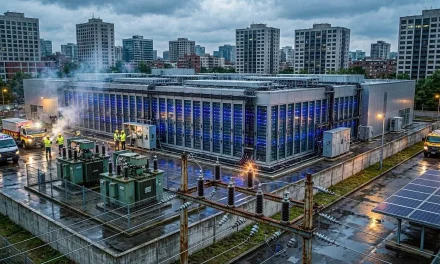
I seem to write about data centers a lot in the Daily Disruptor.
And for good reason. They’re where hundreds of billions of dollars are being invested to support the AI boom.
But this week’s chart reinforces a problem I’ve been highlighting for months now.
It shows how much electricity America’s AI infrastructure expects to consume over the next few years.
And it helps explain why some of the data centers being announced today may take a lot longer to come online than you might expect.
The Power Bottleneck
On a positive note, our chart of the week is another example of the extraordinary growth happening across the AI industry.

Image: https://x.com/mzuhair123/status/2060693710657179649?s=12
But it also highlights a huge problem.
According to data compiled by Epoch AI, large AI-focused data centers operating in the United States currently consume about 10.3 gigawatts (GW) of power. That’s already enough electricity to supply millions of homes.
Yet that projected total rises to roughly 35 GW by the end of the decade.
More importantly, most of that increase is expected to happen extremely fast. The model suggests AI data center power demand could more than 3X by 2028.
That’s an enormous amount of electricity for our aging power grid to accommodate.
And it’s the main reason I’ve repeatedly argued that power, not chips, is one of the defining bottlenecks of this phase of the AI boom.
Again, Microsoft, Amazon, Google and Meta are collectively investing hundreds of billions of dollars into AI infrastructure. And Nvidia continues to sell every advanced AI chip it can manufacture.
So capital clearly isn’t the problem.
The problem is that building a data center and powering a data center are becoming two very different things.
In fact, some analysts now expect only about 50% to 60% of planned data center capacity to come online on schedule over the next couple of years.
And delays involving power delivery, utility infrastructure and project execution are becoming increasingly common.
New data from PJM, the nation’s largest grid operator, helps explain why.
Projects that became operational in 2025 spent an average of eight years waiting to connect to the grid. That’s an eternity in the technology industry, where AI capabilities can improve dramatically in a matter of months.
What’s more, roughly two-thirds of the future U.S. AI data center pipeline consists of greenfield projects. In other words, facilities being built on sites that currently have no operational power infrastructure.
That means buildings can be constructed, and servers can be installed. But these data centers can’t come online until enough electricity reaches them.
And that’s where things have become complicated.
Many projects are reportedly waiting for substations, transmission upgrades, utility approvals, cooling systems and grid connections. Some are essentially finished but remain unable to operate at full capacity because the supporting infrastructure hasn’t arrived yet.
Which means the AI race is becoming more than a competition between software models.
It’s turning into a competition between physical infrastructure systems.
And unlike software, infrastructure can move very slowly.
Here’s My Take
American companies remain some of the biggest investors in AI infrastructure anywhere in the world. But this week’s chart reminds us that our electrical infrastructure might not be able to keep pace.
That’s one reason I recommended EnerSys (NYSE: ENS) to my Strategic Fortunes readers in July 2024.
I recognized early on that the AI boom would require far more than advanced chips. It would also require the backup power systems and energy infrastructure needed to keep data centers running around the clock.
Since then, the stock has more than doubled.
But this power bottleneck isn’t just a challenge for technology companies. It’s also a challenge for economic growth, national competitiveness and America’s ability to remain at the center of the AI revolution.
The good news is that bottlenecks can be solved.
America didn’t become an economic superpower by accepting infrastructure constraints. We built the interstate highway system. We brought electricity to nearly every corner of the country. And we created the communications networks that helped power the internet age.
Those projects required an enormous amount of investment and political will.
But they happened because we made them a priority.
The question is whether we’ll show that same urgency again.
Regards,

Ian King
Chief Strategist, Banyan Hill Publishing
Editor’s Note: We’d love to hear from you!
If you want to share your thoughts or suggestions about the Daily Disruptor, or if there are any specific topics you’d like us to cover, just send an email to dailydisruptor@banyanhill.com.
Don’t worry, we won’t reveal your full name in the event we publish a response. So feel free to comment away!