


Twitter traders want you to believe they have the magic indicator that will make you immediately profitable.
After decades in the market, I can tell you no such thing exists.
Even my top patterns can’t be used in a vacuum.
Markets change, and traders need to adapt or perish.
That’s why I highlight my losses just as much as my wins because they keep me honest.
Even an experienced trader like me makes dumb mistakes from time to time.
I want everyone to understand mistakes can and do happen.
Great traders use them to improve their performance and become more profitable.
Here’s how they do it.
Acknowledge Your Mistake
No one likes to admit when they’re wrong.
Frankly, it’s one of the hardest things for any trader to do. It goes against our nature.
Yet, it’s the first and by far the most important step to improving your performance.
Don’t make it self-defeating.
Embrace the mistake and even add in a little humor.
It’s not about making yourself feel bad but rather using the mistake as a catalyst to do better.
There are three categories of mistakes a trader can make:
1. Opportunity, identification and signal.
2. The trade setup.
3. Execution.
I’ll get to the causes in a minute. Categorizing mistakes helps to narrow down the solutions to fix those problems.
Let’s dive into my example and see where it falls.
Soon after its IPO, I talked specifically about Shuttle Pharmaceuticals Holdings Inc. (SHPH) and I wasn’t bullish.
In fact, I pointed out that the price action fell into the “Dead Pump Bounce” category — not a spot to buy but a place to short the stock.
And what did I do?
I bought shares on a breakout higher like a freshman.
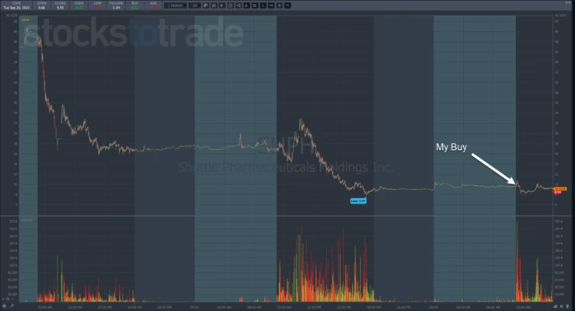
Source: Stock to Trade
Here’s where I bought SHPH…
Dip buys are great setups. But they only work in the right context.
I failed to identify the opportunity and signal. Or in this case, I identified an opportunity that didn’t actually exist.
Correcting Mistakes
Once I knew the problem, I acknowledged my mistake.
I also acknowledged what I did right. The setup and size were appropriate, plus I executed the trade reasonably well.
So for me, it’s about sticking to my plan. I need to practice staying away from non-existent opportunities.
The best way for me to do that is to write it out and explain what I see and why I’m taking the trade.
Plus, I remind myself of the mistake for a few days or even weeks to ensure I avoid the same problem.
It might seem a bit redundant, but repetition embeds the skills into our minds and muscle memory.
The more we actively focus on doing or not doing a particular task, the sooner it becomes second nature.
Look for Patterns
Sometimes mistakes pop up out of nowhere and then disappear.
If you look through my past trades, you’ll notice there aren’t a lot of mistakes in either my winners or my losers.
Why is that? For me, it comes down to focus.
I travel a lot, building schools in Bali and meeting with my students. I don’t always have enough time to trade and certainly don’t get enough sleep.
When I’m in this mode, my trading can suffer from more dumb mistakes than I care to admit.
To combat this, I make it a point to live and breathe my #1 rule: cut losses quickly and keep them small.
A dumb mistake can turn into a massive one if I’m not careful…
Adhering to and practicing this rule daily ensures that no one mistake or even a series of them wipes out my account and provides enough time for me to recognize and correct them.
If you have any questions, email me at SykesDaily@BanyanHill.com.
Cheers,

Tim Sykes
Editor, Tim Sykes Daily
🚀 Note: The SpaceX IPO will be in the news every day until it happens. Space stocks could get CRAAAZY. Just watch the patterns and learn from Tim’s mistakes. There are still good opportunities out there. As they say, a rising tide lifts all ships. So if you want to ride the tide, check out these under-the-radar space opportunities.