

In our last issue, we talked about how the AI boom is starting to push infrastructure beyond the normal limits.
Our power grids are struggling to keep up with rising electricity demand from artificial intelligence. And that’s causing some companies to explore ideas that would’ve sounded absurd just a few years ago…
Including floating AI data centers powered by ocean waves.
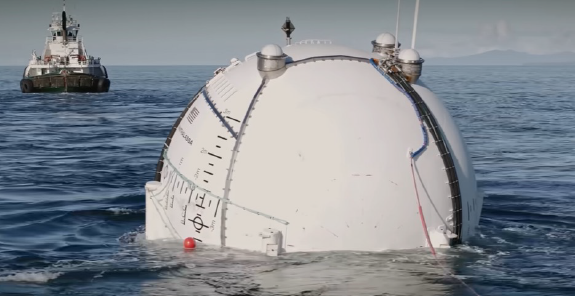
Image: Panthalassa
But the ocean might not be the outer limit to this story.
Because some companies are already setting their sights much farther away.
All the way to the Moon.
A Lunar Gold Rush
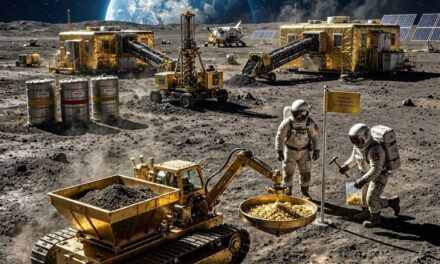
For decades now, futurists have been dreaming about a modern gold rush on the Moon.
And one of the biggest reasons is a rare isotope called helium-3.
Scientists believe helium-3 could someday help fuel advanced fusion reactors, a technology many researchers hope could provide abundant, clean energy with far less radioactive waste than traditional nuclear power.
Researchers estimate the Moon could contain as much as one billion kilograms of helium-3, scattered across the lunar surface after billions of years of bombardment from the solar wind. That amount could theoretically provide enough energy to power humanity for centuries, perhaps even millennia.
That means helium-3 could potentially solve all of our power issues here on Earth.
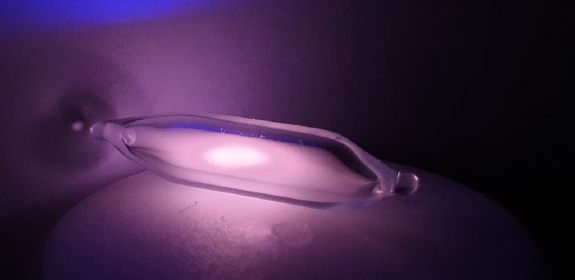
Image: Wikipedia
And if we can figure out how to mine and use it economically, its value could reach into the trillions of dollars.
But before a lunar gold rush comes to pass — and well before we get to giant mining operations and cities under glass domes — somebody has to build the basic plumbing on the Moon.
And that’s good news for investors, because that’s often where the biggest opportunities come from.
During the California gold rush, the prospectors digging for gold were rarely the ones who struck it rich. The biggest fortunes usually went to the businesses building the infrastructure that made the gold rush possible in the first place.
Today, that kind of work is about to start on the Moon.
For example, we need reliable ways to transmit data, navigate and stay connected across cislunar space, the region between Earth and the Moon, for spacecraft, landers and research stations to operate around the Moon.
That’s why NASA awarded Intuitive Machines (Nasdaq: LUNR) a Near Space Network contract worth up to $4.8 billion to help provide communication infrastructure for future lunar missions.
Power is another huge piece of the puzzle.
Before you can have factories, transportation networks or industrial activity on the Moon, you need dependable power systems that people can build around.
But the Moon is a brutal place to operate. A lunar night lasts about two Earth weeks, which means equipment can go long stretches without sunlight. And temperatures can swing wildly between daylight and darkness.
That’s why Astrobotic is developing LunaGrid, a system designed to generate power for future operations on the Moon.
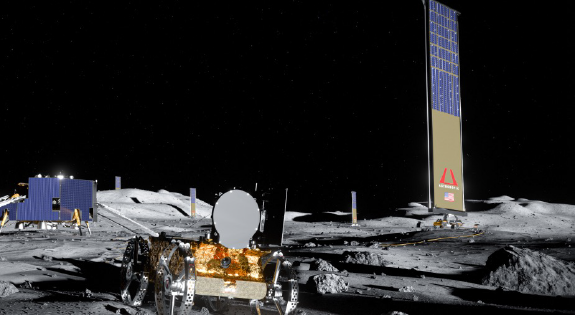
Image: Astrobotic
NASA has also funded the company’s work on a giant vertical solar array that could someday help keep lunar missions running during the Moon’s long periods of darkness.
Transportation is just as important.
Equipment, supplies and construction materials will need to move back and forth regularly between Earth and the Moon for a lunar economy to work. That’s why companies are now building systems designed to accomplish this task on a consistent basis.
And investors are paying attention.
PitchBook estimates that startups tied to lunar infrastructure attracted roughly $1.9 billion in 2025, including companies focused on landers, transfer vehicles and lunar utility systems.
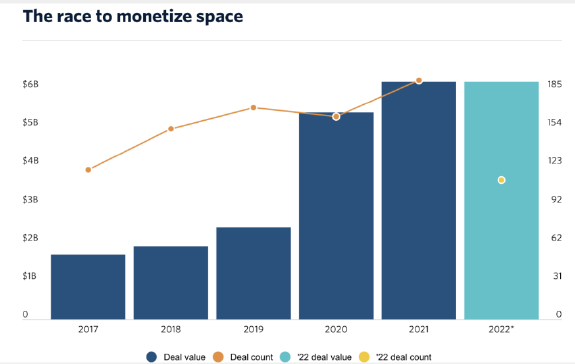
Image: Pitchbook
This tells you that private capital is already eager to fund the basic systems a future Moon economy needs to function.
Construction is the next obvious step.
If humans want to build long-term operations on the Moon, they simply can’t ship every road, landing pad and habitat component from Earth. That would be far too expensive.
So researchers are looking at ways to use lunar regolith, the dust and crushed rock already sitting on the Moon’s surface, as a building material.
That could eventually make it possible to build landing pads, roads, shielding or even buildings from the Moon itself.
That’s how we’ll be able to build the foundation of a lunar economy without having to haul everything we need 240,000 miles from Earth.
And if this market develops, it could become massive very quickly.
PwC recently projected that the lunar economy could generate up to $127 billion in revenue by 2050.
But if the Moon is about to become the next great frontier economy, it’ll have to be built the same way every other frontier economy was built.
Starting with its infrastructure.
Here’s My Take
The AI boom is forcing companies to rethink the physical limits of infrastructure here on Earth.
That’s why we’re seeing serious money flow into ideas like ocean-based data centers, nuclear power for AI campuses and new energy systems designed to support massive compute demand.
The Moon might seem too “far out” to be part of this story. But I don’t think it is.
As technology gets bigger, faster and more energy-hungry, the infrastructure supporting it has to expand into places that once seemed unrealistic.
Someday soon, that might mean our moon.
Regards,

Ian King
Chief Strategist, Banyan Hill Publishing
Editor’s Note: We’d love to hear from you!
If you want to share your thoughts or suggestions about the Daily Disruptor, or if there are any specific topics you’d like us to cover, just send an email to dailydisruptor@banyanhill.com.
Don’t worry, we won’t reveal your full name in the event we publish a response. So feel free to comment away!