
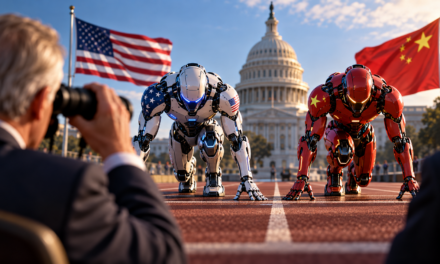
Back in July, I told you how Chinese technology companies were finding ways to compete with America’s most advanced artificial intelligence systems.
Some were using a technique called distillation to learn from American AI models and develop cheaper alternatives.
Anthropic reported that Chinese companies had created roughly 24,000 accounts and generated more than 16 million conversations with its Claude models, allegedly using those interactions to train competing systems.
That creates a problem for Washington.
For years, the U.S. government has tried to slow China’s AI development by restricting its access to advanced computer chips.
But that hasn’t stopped Chinese companies from building AI models that rival some of America’s best. And they’re finding ways to do it for far less money.
If powerful AI becomes cheap and widely available, then the real advantage might go to the countries and companies that find the best ways to use it.
And with the midterm elections approaching, I think that’s something Washington needs to understand.
America’s AI Blind Spot
Companies like Nvidia (Nasdaq: NVDA) have become enormously valuable because their chips provide the computing power needed to run today’s most advanced AI systems.
But as we’ve seen with DeepSeek and Moonshot AI, Chinese developers are finding ways to compete without having access to America’s best chips.
And they’re not limiting their ambitions to AI software.
China has invested heavily in its electrical grid, advanced manufacturing, robotics and other infrastructure needed to support the next generation of technology.
Meanwhile, American companies are spending hundreds of billions of dollars building enormous AI data centers.

And as I’ve warned several times this year, our aging electrical grid is struggling to keep up.
So the competition isn’t simply about who has the best chips or smartest AI models. It’s also about who can build the infrastructure needed to support AI and put the technology to work.
Earlier this month, I showed you that most American businesses are still in the earliest stages of adopting AI.
Only about 2% of S&P 500 companies publicly report a specific AI performance metric that they regularly track. And according to Deloitte, only about 11% of U.S. companies have AI agents operating in production.
That leaves enormous room for growth as businesses begin using AI to automate work, improve manufacturing, manage logistics and develop new products.
And America needs to make sure its businesses can take full advantage of that opportunity.

After the midterm elections, Congress could put new limits on Chinese AI or make it harder for American companies to use it.
As I explained in July, Washington could even ban certain Chinese AI models from being used in the U.S. But even without a ban, American businesses might choose to pay more for AI they trust to keep their information safe.
Either way, American AI companies could benefit.
And investors won’t necessarily wait for Congress to act. Even the possibility of new rules could send technology stocks higher or lower.
That’s worth keeping in mind as we approach November 3rd.
My colleague Addison Wiggin has been studying how stocks perform around midterm elections. And he found something interesting.
Since 1950, the S&P 500 has risen in the 12 months following all 19 midterm elections, gaining an average of 15.1%.
And much of those gains came quickly.
During the first three months after those elections, stocks rose an average of 7.7%.
Addison estimates that a similar rally this year could add as much as $10.5 trillion to the S&P 500’s total value.
Of course, that doesn’t mean there will be another rally this time.
But with AI changing so much of the economy, the decisions made in Washington after November 3rd could have consequences that last well beyond the next election.
Here’s My Take
I believe America still has enormous AI advantages.
But restricting China’s access to advanced chips won’t be enough to preserve them.
We also need to make sure American businesses have the tools and infrastructure to put AI to work.
And that’s something that will matter regardless of which party controls Congress.
But the midterm elections could still majorly influence which companies benefit most in the months ahead.
On Tuesday, October 27, at 8 p.m. ET, Addison is hosting a free live presentation where he’ll share his forecast for the House and Senate, including his predictions for individual races.
He’ll also reveal three potential trades identified by the AI system behind his Grey Swan Trader service.
And he’ll give attendees two free stock recommendations, including one to consider buying before November 3rd and another he believes investors should sell before the votes are counted.
No one can say for sure how Wall Street will react to the election.
But with the AI revolution still in its earliest stages, the companies that figure out how to put this technology to work could be among its biggest winners.
Click here to reserve your free spot for Tuesday night.
Regards,

Ian King
Chief Strategist, Banyan Hill Publishing
Editor’s Note: We’d love to hear from you!
If you want to share your thoughts or suggestions about the Daily Disruptor, or if there are any specific topics you’d like us to cover, just send an email to dailydisruptor@banyanhill.com.
Don’t worry, we won’t reveal your full name in the event we publish a response. So feel free to comment away!