
When most people think about the robot revolution, they probably picture something like Tesla’s Optimus.
Something with two arms, two legs and a head.

Basically, a mechanical version of us.
But I wonder if we’re thinking about the robot revolution all wrong.
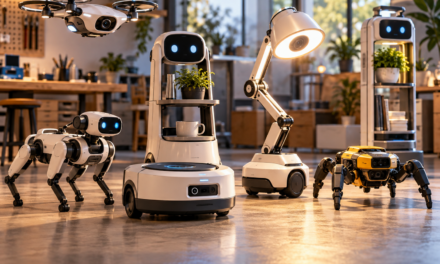
Consider Star Wars. Yes, C-3PO looks like a person. But R2-D2 looks like a trash can on wheels. And the movies are filled with dozens of robots of almost every shape and size imaginable.
Obviously, Star Wars is science fiction. But I believe its vision of our robot future could end up being quite accurate.
Because artificial intelligence doesn’t need a human form to exist in the physical world.
It just needs a body.
And thanks to AI, we’re getting much closer to a world where that body can be designed for almost any job we can imagine.
Design Your Own Robot
Until recently, designing a robot required expertise in everything from mechanical engineering and electronics to computer programming.
But AI is changing this dynamic. And a new project called LuxoBench reveals what the future of robotics could look like.
Researchers started with the concept for a small robotic desk lamp and gave several leading AI models a simple challenge:
Make it real.

The models had to figure out what components they’d need, how those components should fit together and what software would make everything work.
One design used a Raspberry Pi computer, a camera, servo motors and a small display. The AI also generated assembly instructions and the code needed to control the robot.
And the estimated cost of the parts was less than $250.
To be clear, these designs haven’t been physically built and tested yet. LuxoBench was created to find out how well today’s AI models could handle the different challenges involved in building a robot.
But I’m fascinated by the bigger idea here.
The same AI that can help you write an email or create a website is starting to understand how to build things in the physical world.
And LuxoBench isn’t the only example.
Researchers recently demonstrated an AI system that allows people with little or no engineering experience to create personalized robots using something as simple as an image or text description.
You tell the AI what you want to build, and it can figure out what motors are needed, then design the mechanical parts and create files that can be manufactured with a 3D printer.
In some cases, a process that normally requires specialized engineering knowledge can be reduced to hours.
That dramatically lowers the barrier to creating a robot. And it could become even more powerful when you combine it with what’s happening on the software side.
As I’ve written about before, artificial intelligence is becoming the “brain” that allows robots to understand their surroundings and figure out what to do next.
Now AI can also help us design the body around that brain.
And that changes the equation.
Think about a Roomba.

Image: iRobot
It doesn’t have arms or legs because it doesn’t need them. Its body was designed to move across your floor and clean it.
Now imagine applying that same idea to much more intelligent machines.
Maybe you want a small robot that sits on your kid’s desk to help with homework. Or one that rolls around the house checking on an elderly parent.
Maybe you want a robot for your workshop that can watch what you’re doing and talk you through a repair.
None of these machines needs to look like Optimus. In fact, forcing them into a humanoid body could make them both more expensive and less useful.
That’s why I think we’re looking at something much bigger than the race to build humanoid robots.
About 540 million years ago, something incredible happened on Earth. Over a relatively short period of geological time, animal life diversified dramatically. New body plans appeared and organisms began filling all kinds of different ecological niches.
Scientists call it the Cambrian explosion.
I believe robotics could be approaching its own version of this phenomenon.
Instead of one general-purpose robot eventually taking over our homes, AI could lead to an explosion of different machines built for different jobs.
Some might walk. Some might roll. Some might even fly. Others could simply sit on a shelf or desk and barely move at all.
But they’ll all be powered by a similar underlying intelligence.
Here’s My Take
AI gives machines the potential to become much more adaptable. And it could help make their physical forms much more adaptable too.
That could change the way robots are created.
Instead of waiting for a company to design the perfect robot for millions of people, you might eventually be able to tell AI exactly what kind of robot you want.
And a lot of the technology needed to make that happen already exists.
Cheap computers like Raspberry Pi give hobbyists plenty of processing power. 3D printers can produce custom physical parts. Cameras and sensors have become inexpensive. And open-source AI models can run locally on your own home computer.
Together, these technologies could turn a robot from something you buy into something you design for a specific job.
A physical form of AI.
And just like the droids in Star Wars, that robot could take whatever form makes the most sense for what you need it to do.
Regards,

Ian King
Chief Strategist, Banyan Hill Publishing
Editor’s Note: We’d love to hear from you!
If you want to share your thoughts or suggestions about the Daily Disruptor, or if there are any specific topics you’d like us to cover, just send an email to dailydisruptor@banyanhill.com.
Don’t worry, we won’t reveal your full name in the event we publish a response. So feel free to comment away!