

Here’s your Monday Motivation…
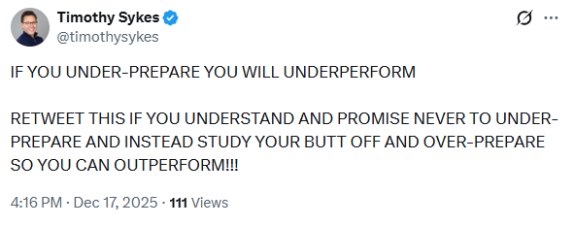
This is one of the first lessons I share with my students. If you under-prepare, you will underperform.
As you know, I have mentored thousands of students and helped more than 30 of them become millionaires.
Countless others have used my strategies to achieve six-figure profits and transform their financial lives.
And just like I coached them, I’ll coach you.
Some of my students are killing it. But some haven’t figured it out just yet.
Don’t worry, there’s still time. The market’s not going anywhere. And the patterns that we use to trade don’t change.
But sooner or later, you’ve got to start taking this seriously if you want to succeed as a trader.
Maybe you already are taking it seriously, and this Tim Sykes Daily is just a reminder to keep pushing!
Let’s start with the basics…
Understanding Trading Terms
Trading terms in the stock market can seem like a foreign language to the uninitiated. With a plethora of terms and jargon, the trading glossary can be overwhelming for beginners.
I know it’s a lot… but it’s the starting place for any self-sufficient trader!
When you read about sales or volume, you shouldn’t have to consult a dictionary…
Let’s break it down!
Trading terms are the language of the market.
Understanding trading terms is like learning a new language. It’s about becoming fluent in the language of the market, so you can navigate the trading world with confidence and ease.
Whether you’re a novice trader just starting out, or a seasoned trader looking to brush up on your terminology, understanding trading terms is a crucial part of your trading journey.
Without a solid understanding of trading terminology, a trader is like a ship without a compass, navigating the vast ocean of the stock market.
The importance of understanding trading terminology cannot be overstated.
It’s the foundation of any successful trading strategy. It’s what allows traders to understand the market, to make sense of market trends and patterns, and to make informed decisions about when to buy and sell.
Top 10 Basic Day Trading Terminology
There are many types of trading terms, ranging from basic terms that describe the buying and selling of assets, to more complex terms that describe specific trading strategies and market conditions.
Some terms are used across all types of trading, while others are specific to certain types of trading, such as day trading, forex trading, or futures trading.
Remember, the more tools you have in your trading toolkit, the better equipped you’ll be to navigate the market.
Day trading is a type of trading where traders buy and sell assets within the same trading day. Here are the top 10 basic day trading terms that every trader should know.
Equity
Equity refers to the ownership interest in a company. In the context of trading, it refers to the value of an investor’s trading account, excluding any margin loans. Understanding equity is crucial for managing your risk and maximizing your profits in the market.
Ask/Offer
The ask or offer price is the lowest price that a seller is willing to accept for an asset. It’s the price you’ll need to pay if you want to buy the asset. Understanding the ask price is crucial for making informed buying decisions in the market.
Bid
The bid price is the highest price that a buyer is willing to pay for an asset. It’s the price you’ll receive if you want to sell the asset. Understanding the bid price is crucial for making informed selling decisions in the market.
Spread
The spread is the difference between the bid price and the ask price. It’s essentially the cost of trading, with lower spreads generally being better for traders. Understanding the spread is crucial for managing your trading costs and maximizing your profits in the market.
Broker
A broker is a person or company that facilitates trades between buyers and sellers. They provide the platform for trading and often provide additional services such as research and advice. Understanding the role of a broker is crucial for navigating the trading world and making the most of your trading experience.
Exchange
An exchange is a marketplace where buyers and sellers trade assets. Exchanges can be physical locations, like the New York Stock Exchange, or electronic platforms, like the Nasdaq. Understanding how exchanges work is crucial for understanding the mechanics of the market and how trades are executed.
Bull Market / Bear Market
A bull market is a market condition where prices are rising or are expected to rise, while a bear market is a market condition where prices are falling or are expected to fall. Understanding these terms is crucial for understanding market trends and making informed trading decisions.
Trading Account
A trading account is an account held by a trader with a broker that is used to conduct trading activities. Understanding how a trading account works is crucial for managing your trades and your trading capital.
Volatility
Volatility refers to the degree of variation in a financial instrument’s trading price over a certain period of time. High volatility means that the price of the asset can change dramatically over a short period, while low volatility means that the price changes at a steady pace. Understanding volatility is crucial for managing your risk and making informed trading decisions.
Yield
Yield refers to the earnings generated and realized on an investment over a particular period. It’s expressed as a percentage based on the investment’s cost or current market value. Understanding yield is crucial for assessing the profitability of your investments.
What’s Next After Learning Stock Market Terms?
Learning stock market terms is just the first step on your trading journey. Once you’ve mastered the basics, it’s time to put your knowledge into practice and start trading…
Continuing education and improving trading skills is a lifelong journey.
The market is always changing, and there’s always something new to learn.
Whether it’s learning about new trading strategies, staying up-to-date with market news, or refining your trading skills, continuing education is a crucial part of any trader’s journey.
During my time in the market, I’ve learned a lot — and I share it all with my students.
That’s why I’ll share these vital lessons in Tim Sykes Daily.
The goal? Help you help yourself… I want you to trade smart, stay safe, and be self-sufficient.
It’s up to you to do the heavy lifting. I want you to use my teachings to develop your strategy.
Are there any terms you’re still curious about? Let me know — I love hearing from my readers!
Shoot me an email at SykesDaily@BanyanHill.com.
Tomorrow, I’ll show you how one of my students put these terms to use in his trading strategy … and went from humble beginnings to millionaire!
Cheers,

Tim Sykes
Editor, Tim Sykes Daily