
Andy,
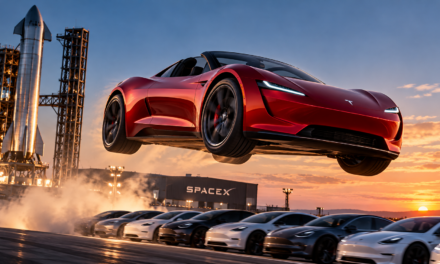
Last Thursday, Tesla (Nasdaq: TSLA) unveiled its long-awaited Roadster at a SpaceX (Nasdaq: SPCX) rocket testing facility in Texas.
By now you’ve probably seen the video, and you know it wasn’t your typical new car announcement.
The Roadster accelerated from zero to 60 miles per hour in less than a second, a feat that would make it the fastest-accelerating production car in history. That alone would have been enough to make headlines around the world.
But then it drove upside down, launched itself into the air, flipped over a row of Teslas and landed like the flying DeLorean from Back to the Future.

Image: Tesla
It was a mind-blowing display of engineering from a company that’s already transformed the automotive industry.
But why did Musk choose a SpaceX facility to unveil his latest Tesla? And why was technology developed for rockets suddenly being used to make cars fly?
I’m confident those details weren’t a coincidence.
And I suspect the biggest surprise from last week’s demonstration may have had very little to do with the Roadster itself.
Is Musk Planning Something Bigger?
Within hours of last week’s Roadster demonstration, Wall Street was buzzing about a possible merger between Tesla and SpaceX.
Barclays analyst Dan Levy believes a deal could be announced before Tesla’s annual shareholder meeting on December 3. And he thinks SpaceX, which went public earlier this year, could acquire Tesla.
I’ve suspected for some time that Musk would eventually merge these companies. It’s a major reason TSLA is a hold in our Strategic Fortunes model portfolio.
And the more I think about it, the more sense it makes.
After all, Tesla makes electric vehicles, batteries and humanoid robots. SpaceX builds rockets and operates Starlink, its global satellite communications network.
And what do both companies have in common?
Artificial intelligence.
Tesla is developing what Musk calls physical AI, artificial intelligence that operates in the real world.
Think about Tesla’s self-driving vehicles and its Optimus humanoid robots.

Image: Tesla
Both need AI systems that can understand their surroundings, make decisions and respond to constantly changing conditions.
Meanwhile, SpaceX has become a major player in AI through its acquisition of Musk’s xAI business, which developed the Grok chatbot.
It’s also investing heavily in the computing infrastructure needed to train and operate powerful AI systems.
By combining those capabilities, Tesla could use Grok’s technology to make its robots better at understanding and responding to people. SpaceX’s Starlink network could provide connectivity for Tesla vehicles around the world. And Tesla’s energy storage systems could help power the enormous data centers needed to run AI.
But another reason why Musk might want to bring these businesses together is Terafab.
Earlier this year, Tesla and SpaceX announced plans to build an enormous semiconductor manufacturing project in Texas, with the goal of producing advanced computer chips that power everything from self-driving cars and humanoid robots to AI systems operating in space.
Today, developing powerful AI requires enormous amounts of computing power. That means either buying advanced chips from companies like Nvidia or manufacturing specialized processors of your own.
Musk would prefer to do much more of the latter.
With Terafab, his companies could design and manufacture chips for their own AI applications, reducing dependence on outside suppliers.
And that’s where this merger would really make sense.
Instead of operating as separate businesses, Tesla and SpaceX could share resources, develop technology together and make decisions under one roof.
In other words, Musk wouldn’t just be combining a car company with a rocket company.
He’d be creating a technology giant that could develop its own AI, manufacture the chips that power it and put that intelligence to work in cars, robots, satellites and other machines.
And yesterday, Musk confirmed that it could be moving closer to reality.
During SpaceX’s quarterly earnings call, he revealed that Tesla and SpaceX have formed special committees of independent directors to explore a potential merger.

Musk said there’s “a lot of merit” to combining the companies, pointing specifically to opportunities in AI software, chip manufacturing and robotics.
In other words, many of the same reasons I’ve been arguing that a merger makes sense.
Of course, a deal is far from certain. Musk isn’t participating in the discussions because of his ownership stakes in both companies. And any merger would need shareholder approval.
But the fact that both companies are now formally exploring the idea is a major development.
And Musk has already demonstrated how technologies developed by one of his companies can transform another.
Last week’s flying Roadster was a spectacular example.
And I suspect it won’t be the last.
Here’s My Take
Tesla doesn’t need to merge with SpaceX to have a great future.
In fact, I think the company could be heading toward one of its strongest quarters ever.
More and more people in my life are talking about buying a Tesla. Even my wife said she’s interested in getting one.
And I can understand why.
If you’re shopping for a new car in the $50,000 to $60,000 range, why wouldn’t you want one that could eventually drive itself?
Tesla’s Full Self-Driving technology can already navigate city streets, change lanes and respond to traffic lights. It still requires an attentive driver, but the software is improving, and it currently costs just $99 a month.

Think about what that could mean for someone like my mother, who doesn’t particularly want to drive anymore. Someday soon, she could simply get into the car, tell it where she wanted to go and let the vehicle handle everything else.
That kind of independence could change millions of lives. And I believe it’s becoming a powerful reason to consider buying a Tesla.
The company’s latest sales figures are encouraging, too.
Tesla delivered 486,532 vehicles in the third quarter, beating Wall Street’s expectations by roughly 25,000. That’s still about 2% below last year’s record, but I think the fourth quarter could be even stronger.
Especially after last week’s Roadster demonstration, which reminded millions of people just how far Tesla is willing to push the boundaries of what’s possible.
But I’d love to know what you think. Would you ever buy a car that could drive itself?
Send an email with your thoughts to dailydisruptor@banyanhill.com.
We won’t reveal your full name if we publish your response, so don’t hold back. I’d love to hear what you really think.
Regards,

Ian King
Chief Strategist, Banyan Hill Publishing