


Last week, I talked about how the U.S. might not be ready for the next phase of artificial intelligence.
Today, I’m going to flip the script.
Because plenty of critics still believe that the AI boom is overhyped.
Their argument is that AI has shown a lot of improvement over the past few years because researchers picked “low-hanging fruit.” But they insist that, from here, progress will become slower, harder and much more expensive.
In other words, they believe AI’s biggest breakthroughs could already be behind us.
But our chart of the week suggests that the opposite is true.
Stanford’s AI Index
Every year since 2017, Stanford University’s Institute for Human-Centered Artificial Intelligence has published its AI Index Report, one of the most respected annual reviews of the industry.
This report tracks everything from technical benchmarks and adoption rates to investment trends and global competition.
And this year’s conclusion was as straightforward as it gets: “AI capability is not plateauing. It is accelerating and reaching more people than ever.”
The first chart in the report helps explain why.
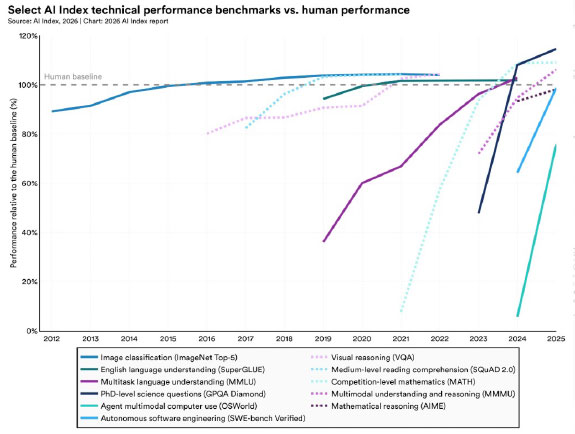
Source: Stanford AI Index Report 2026
It tracks the performance of frontier AI systems across a range of difficult benchmarks over time. And as you can see, instead of flattening out, many of the curves are still rising sharply higher into human-level performance.
One example from the report really stands out to me.
In just one year, AI systems went from solving roughly 60% of software engineering problems to nearly 100%. This huge leap shows how AI is rapidly evolving from a “sometimes useful” tool into something that’s “consistently reliable.”
But AI’s acceleration isn’t limited to coding.
Stanford’s report shows progress happening across multiple categories at once.
Humanity’s Last Exam, a benchmark designed to test expert-level reasoning across difficult academic subjects, reportedly improved from 8.8% to more than 38% in about a year. Some frontier systems are already scoring above 50% on this test.
Cybersecurity agent accuracy reportedly climbed from 15% to 93%.
And some models now outperform human baselines on advanced science and reasoning tasks.
At the same time, the infrastructure supporting all of these advances is scaling at an extraordinary speed.
Stanford cites estimates showing global AI compute capacity has been growing more than 3X annually since 2022. Overall AI compute is estimated to have increased roughly 30-fold since 2021.
That helps explain why global AI investment reportedly reached nearly $582 billion in 2025 alone.
And while the technology improves, adoption continues spreading at a historic speed.
According to Stanford, generative AI is spreading faster than the personal computer or the internet did in their early years.
The report also found that organizational AI adoption climbed to 88% in 2025, while four out of five university students now use generative AI.
In other words, AI technology is rapidly improving at the same time it’s becoming deeply embedded in our everyday lives.
We’ve seen this kind of inflection point before. It’s the same thing that happened to both the internet and smartphones when they started rapidly going mainstream.
I believe we’re at that same point today with AI.
Here’s My Take
Stanford’s report isn’t promotional material from an AI company that’s trying to raise money.
It’s just the facts.
It even openly discusses AI’s weaknesses. For example, some advanced systems can now perform at gold-medal levels on elite mathematics benchmarks, yet they can also still struggle with surprisingly basic tasks like reliably reading analog clocks.
This uneven progress is what’s referred to as the “jagged frontier” of AI.
But even with its jagged edges, you can see where this is heading.
With AI adoption spreading globally, and hundreds of billions of dollars flowing into the data centers, power systems and compute networks needed to support it…
AI is becoming infrastructure.
Ignore this trend at your own peril.
Regards,

Ian King
Chief Strategist, Banyan Hill Publishing
Editor’s Note: We’d love to hear from you!
If you want to share your thoughts or suggestions about the Daily Disruptor, or if there are any specific topics you’d like us to cover, just send an email to dailydisruptor@banyanhill.com.
Don’t worry, we won’t reveal your full name in the event we publish a response. So feel free to comment away!