

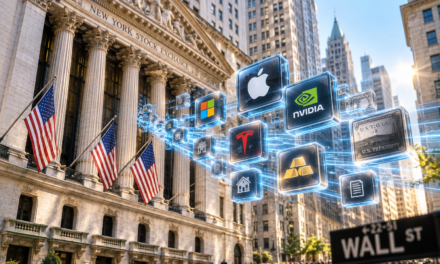
A year ago, I predicted that tokenization was inevitable.
In fact, I predicted that within a decade, most financial assets, from stocks and Treasuries to real estate, would exist as digital tokens.
At the time, Wall Street was only beginning to experiment with putting traditional assets on the blockchain.
But this week’s chart suggests tokenization is happening even faster than I expected.
Tokenization Is Accelerating
Tokenization takes an asset that already exists, such as a stock or Treasury bond, and creates a digital version that can be bought and sold using blockchain technology.
That digital token can represent ownership of the stock or give an investor exposure to its value, depending on how the token is structured.
This might sound like a small change. But moving assets onto a blockchain can make them easier to trade around the clock, transfer between investors and settle without relying on all the traditional plumbing that keeps Wall Street running.
And tokenization is happening fast.
This week’s chart comes from RWA.xyz, which tracks real-world assets moving onto blockchains. It shows the number of onchain holders of tokenized equities, or stocks that have been turned into blockchain-based tokens.
Take a look.

Source: RWA.xyz
Just a little over a year ago, there were only about 45,000 onchain holders of tokenized equities. By January of this year, that number had more than doubled to 103,000.
And recently, tokenization has really taken off.
The number reached 367,000 in July. In August, it more than doubled to 810,000. And this month, it exploded to roughly 1.9 million.
That’s more than an 18X increase since January.
And what’s shocking is how quickly this growth is accelerating. It took roughly five months for the number of holders to essentially double from 103,000 to 247,000. But it only took three more months to add another 1.6 million.
Now, I want to be clear about what this chart measures.
Those 1.9 million holders don’t necessarily represent 1.9 million individual people. Blockchain data tracks digital addresses, and one person can control more than one address.
But that doesn’t change what the trend is telling us.
Tokenized stocks are moving into the mainstream.
There are several reasons why it’s happening, and one of the biggest is that blockchains don’t keep bankers’ hours.
The regular U.S. stock market is open from 9:30 a.m. until 4 p.m. ET on weekdays. If you want to trade on Saturday afternoon, you’re out of luck.
But crypto markets work differently.
Bitcoin doesn’t care whether it’s Tuesday morning or Christmas night. It can trade 24 hours a day, seven days a week.
Tokenization can bring some of that same flexibility to traditional assets.
That means an investor in Europe or Asia doesn’t necessarily have to arrange their day around the opening bell in New York. And an American investor doesn’t necessarily have to wait until Monday morning to react to news that breaks over the weekend.
That appetite for around-the-clock markets is already showing up in the data.
Jupiter, one of the largest trading platforms on the Solana blockchain, says a majority of its tokenized equity trading now takes place outside of regular U.S. market hours.
And Wall Street is moving in the same direction.
In fact, we got another major sign of that this morning,
The Securities and Exchange Commission (SEC) unveiled a new “Innovation Exemption” that will allow qualifying blockchain-based trading platforms to offer tokenized versions of U.S. stocks without having to follow some of the rules that govern traditional stock exchanges.
The exemption is effective immediately and is designed to make it easier for tokenized securities to trade here in the U.S.
And that’s not the only change the SEC is considering.
Nasdaq has been working toward nearly 24-hour weekday trading. And today, the SEC is holding a roundtable specifically focused on the challenges of expanding stock trading around the clock.
But convenience is only part of what’s driving this boom.
Tokenization can also give investors around the world easier access to assets that have traditionally been difficult or expensive to own.
And we’re entering an extraordinary moment for exactly that kind of demand.
Here’s My Take
SpaceX went public earlier this year in one of the most closely watched IPOs in history. OpenAI and Anthropic are also heading toward public offerings.
These are companies investors have wanted access to for years.
Tokenization creates an entirely new way for financial platforms to bring shares of companies like these to investors around the world.
And stocks are only the beginning. Treasuries, bonds, funds, commodities and real estate can all be tokenized too.
That’s why I believe this week’s chart reveals something more profound than a sudden surge of interest in tokenized stocks.
We’re watching the entire financial system moving onto a new set of rails.
Regards,

Ian King
Chief Strategist, Banyan Hill Publishing
Editor’s Note: We’d love to hear from you!
If you want to share your thoughts or suggestions about the Daily Disruptor, or if there are any specific topics you’d like us to cover, just send an email to dailydisruptor@banyanhill.com.
Don’t worry, we won’t reveal your full name in the event we publish a response. So feel free to comment away!