



Too many traders panic in the morning right at the open.
The weird thing is…
Morning panics create opportunity.
Over the past 25+ years, I’ve seen this price action thousands of times.
And it has become my single favorite pattern.
If you’re prepared, it can actually be one of the best low-risk to high-reward trades.
But if you get it wrong, it’s like trying to catch a falling knife.
The Setup: Morning Panic Dip Buys
Once you master the morning panic dip buy, you’ll never look at your alarm clock the same way again.
Here are the basics:
• Don’t come to the market unprepared. Never try to roll out of bed at 9:28 a.m. ET and ask, “Okay, where’s the panic?” You have to be up and ready. And preferably, you’ve already identified potential morning panic stocks the night before.
• Look for stocks that run for several days. I look for recent runners that are overextended. The higher it goes, the more prepared you should be.
• Pay attention to volume. If the volume is going up with the stock, that means more and more traders are interested.
• What’s the float? Ideally, it’s a low-float stock. That creates even more volatility. When a stock’s float rotates multiple times in a day, it’s on everyone’s radar.
• Wait for the flush. Once a multi-day runner starts to slow down, a selloff can turn into a flush fast.
Timing Your Morning Panic Dip Buy Entry
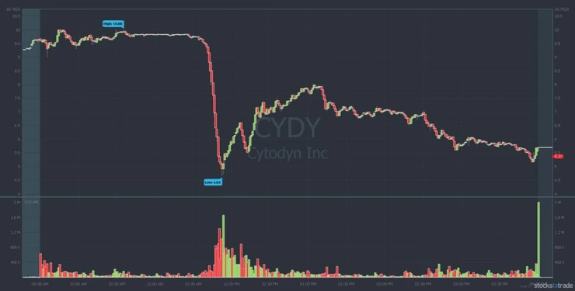
Here’s a classic example of a morning panic:

Source: StocksToTrade
CYDY, 06/30/21, classic morning panic.
Again, if you get it wrong, it’s like trying to catch a falling knife. You’ll end up with bloody hands.
So you have to wait for the turn. And there’s a psychology behind it.
Imagine the stock as it runs up…
Newbies and true believers buy the stock as it runs and then hold as long as they can (because they get greedy).
At the same time, bitter, toxic lemon short sellers start salivating.
For them, this is the next stock they’re going to crush.
Eventually, the selloff begins.
Newbies panic because this amazing stock they’ve seen go for days is going red.
Others get stopped out because they’ve set automatic stop losses.
Then, the short sellers pile in and the panic is on.
At some point, the short sellers decide to cover (to take profits).
When enough short sellers start to cover, that’s the turn.
You can literally see the bids pile up and go higher. And THAT is when it’s…
Time to Strike
Here are a few critical elements of the morning panic pattern:
1. First, the stock must be up a lot — at least 50%. The higher the stock runs, the bigger the panic. I don’t want to try to dip buy a stock that’s only up 20% over a few days. There’s not enough meat on the bone. Wait until they’re extended.
2. Don’t randomly buy a stock that’s down huge in the morning. Companies have bad news all the time. I want a stock that’s a recent runner, not a company with a negative catalyst.
3. Don’t rush into the panic. Stocks can panic much further than you think. I’ve seen stocks drop over 90% in a day. Wait until the stock begins to test support levels and buyers step in on level 2.
4. Cut losses quickly — it’s my #1 rule for a reason. It’s difficult to nail the bottom of panic, so sometimes I enter too early. If that happens, cut the loss and try again. Holding the loss further into the panic could result in a huge loss.
For me, morning panic dip buys are one of the best and most satisfying patterns to trade.
Email me at SykesDaily@BanyanHill.com if you understand the morning panic pattern or have questions about it. I love hearing from you!
Cheers,

Tim Sykes
Editor, Tim Sykes Daily

P.S. We did it! As I mentioned this week, I’m here in Thailand with one goal: rescuing elephants with my charity Karmagawa.
Here I am with one of my heroes, Lek, who has already rescued 100+ elephants who now live cruelty-free at her incredible sanctuary in Chiang Mai.
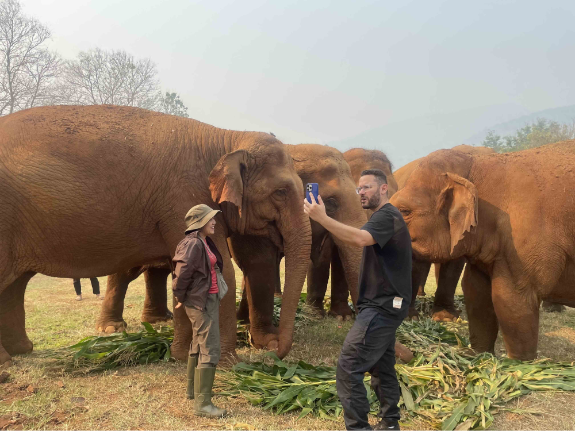

This is the sanctuary that the elephant I’m rescuing for my birthday will soon live — no more riding, beating or starvation as this is Elephant heaven and there’s no animal cruelty/abuse allowed here!
Realize that ANYTHING is possible if you study/work hard enough and remain committed to your goals.
Especially through your ups and downs, especially when the journey is most frustrating/difficult in the beginning, when you don’t have much knowledge/experience!