


The world’s biggest infrastructure booms have all been built around something simple yet incredibly important:
Land.
Railroads needed it to lay down tracks. Oil companies needed it for their pipelines. And telecom networks needed vast tracts of land for towers and fiber-optic cables that stretch across continents.
Today, artificial intelligence is starting to become vital infrastructure too.
But it could be expanding far beyond the limits of land.
Right into the middle of the ocean.
Floating Compute
Earlier this month, a Portland-based startup called Panthalassa announced it had raised $140 million in Series B funding led by Peter Thiel, the PayPal co-founder and early Facebook investor.
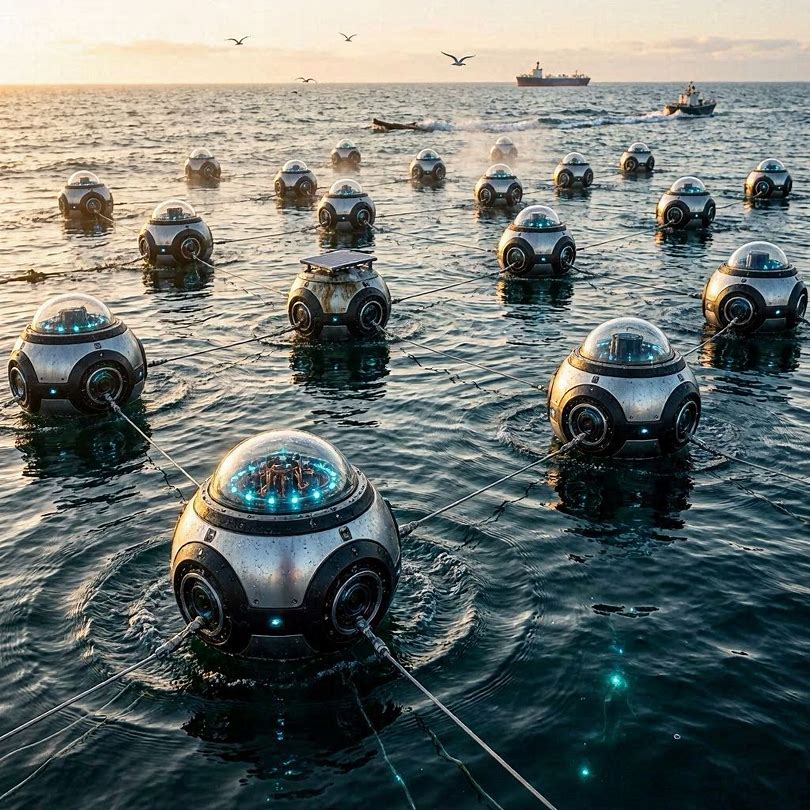
The company’s plan is to build floating AI compute nodes that generate electricity from ocean waves, cool themselves with seawater and transmit data back to land by satellite.

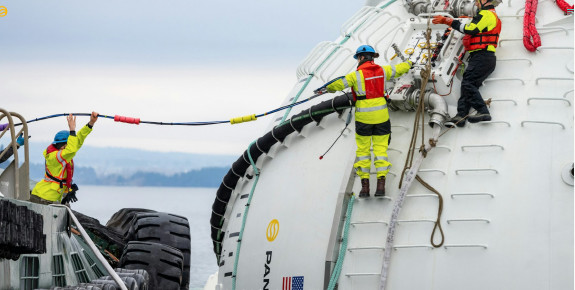
Image: Panthalassa
Why would Panthalassa attempt this difficult feat?
Because the AI boom is becoming an energy problem.
The International Energy Agency (IEA) estimates that global data center electricity use will more than double by 2030. That’s like adding another Japan to the global grid.

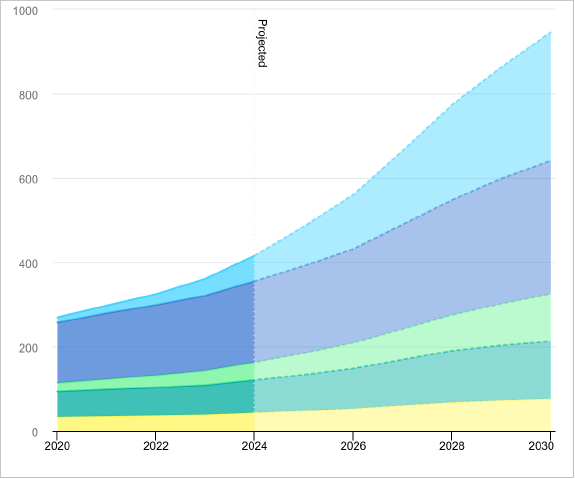
Image: IEA
In the United States alone, it’s estimated that data center power demand could triple from 2023 to 2028.
And that’s creating a serious bottleneck for the AI industry.
Modern AI data centers require enormous amounts of electricity, but also water, land and cooling infrastructure. And while companies can build new AI models relatively quickly, the physical systems needed to support them take longer to scale.
New transmission lines can take years to approve and construct. Power plants can take even longer.
Meanwhile, utilities across the country are suddenly being asked to support electricity demand they didn’t expect to see for another decade.
That’s forcing technology companies to think differently about where the energy they need will come from.
Microsoft and Amazon are backing nuclear projects to help power future AI infrastructure, while Google is exploring advanced geothermal energy. All three of these companies and Meta are signing massive renewable power agreements to secure long-term electricity supply.
In other words, the AI race is no longer just about building better models. It’s increasingly about securing enough infrastructure to run them.
Panthalassa is taking that idea to its logical extreme.
Instead of bringing electricity to AI data centers, the company wants to place AI infrastructure directly on top of a massive untapped energy source.
The ocean.
After all, the ocean is constantly producing energy through waves, tides and motion.
In fact, the Department of Energy estimates that U.S. marine energy resources could generate about 2,300 terawatt-hours of electricity per year.

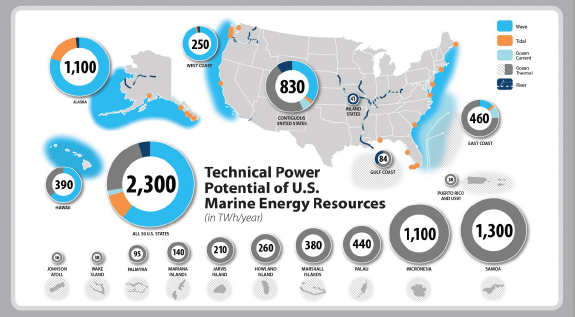
Image: Marine Energy Council
That amounts to more than half of all the electricity generated in the U.S. last year.
It’s why researchers have spent decades trying to harness the ocean’s energy and convert it into electricity.
But wave power has always had one major problem.
The ocean is a terrible place to build machines.
Saltwater corrodes metal, and barnacles grow on everything. Storms can destroy equipment, and maintenance can be very expensive. What’s more, sending electricity from offshore generators back to land requires cables, substations, permits and grid connections.
So wave energy has remained one of those technologies that always seems promising, but never seems practical.
Panthalassa thinks it may have found a way around this problem.
It doesn’t want to send electricity back to land. It wants to use the power right there in the ocean.
Instead of building offshore power systems and then trying to connect them back to the electrical grid, Panthalassa wants to use that energy right where it’s generated.
Its floating platforms are expected to produce electricity from ocean waves, use that power to run AI chips and rely on seawater to keep the systems cool. The data will then be transmitted back to land by satellite.

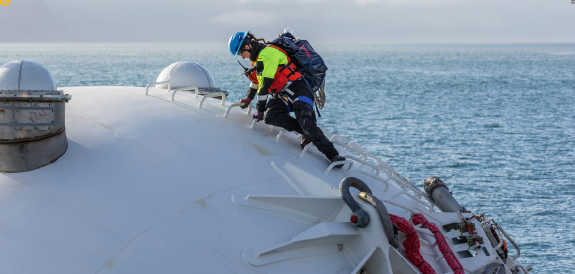
Image: Panthalassa
That won’t solve our energy problems, but it could help mitigate them.
And we already have evidence that data centers and the ocean can work together.
Microsoft’s Project Natick tested an underwater data center off Scotland’s Orkney Islands. After two years under the sea, Microsoft found its servers were eight times more reliable than comparable servers on land.
The company credited the sealed environment, stable temperatures and lack of human disturbance as possible reasons for its success.
Of course, this doesn’t prove that Panthalassa’s ocean nodes will be a success.
Nobody has proven that fleets of floating AI nodes can survive for years in the open ocean. Nobody has proven the satellite bandwidth will be good enough for large commercial workloads. And nobody has proven regulators will be comfortable with thousands of autonomous compute platforms operating far offshore.
But Project Natick proved that the idea isn’t a fantasy.
And AI demand is now so pressing that ideas once considered too “far out” are starting to attract serious capital.
Here’s My Take
Panthalassa’s first Ocean-3 pilot nodes are expected to deploy in the northern Pacific in 2026, with commercial deployments targeted for 2027.
That suggests something important about where artificial intelligence is headed.
The AI boom is becoming so big that it’s starting to push beyond the normal limits of traditional infrastructure. And that’s forcing companies to search for power and computing capacity in places that would’ve sounded absurd just a few years ago.
In our next issue, we’ll look at why some believe the future of AI infrastructure could eventually extend even farther.
All the way to the Moon.
Regards,

Ian King
Chief Strategist, Banyan Hill Publishing

Editor’s Note: We’d love to hear from you!
If you want to share your thoughts or suggestions about the Daily Disruptor, or if there are any specific topics you’d like us to cover, just send an email to dailydisruptor@banyanhill.com.
Don’t worry, we won’t reveal your full name in the event we publish a response. So feel free to comment away!