



Almost every day I get questions about how to build a watchlist.
So, let’s get back to basics…
We’ll go step-by-step through my routine so you can see exactly what I’m doing.
Remember, it’s all about preparation.
SO many traders risk their hard-earned money without doing enough preparation.
You don’t want to make that mistake. Here’s how it really works…
Start Where You Left Off
Most days I wake up before the market opens to build my daily watchlist.
Even when I’m traveling and trading from different time zones, I do my best.


Currently, I’m out exploring Kyoto but still bringing my laptop to capitalize on awesome runners!
Obviously, sometimes my travel schedule gets in the way. So, the first thing I do is open my last watchlist.
For example, yesterday I was making a watchlist and the last one I wrote out was from Friday, November 13.
This will give you an idea of where I begin…
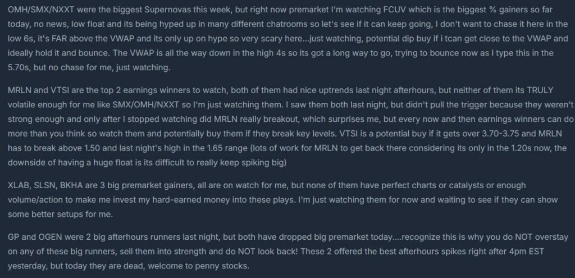

I’m not alone in doing this. Every one of my millionaire students has a watchlist that includes stocks they watched yesterday (or even last week).
I start by copying and pasting the last watchlist into my new watchlist. Then, I read and update it.
Once you start doing this regularly, you’ll see that there are…
Stocks With Similar Trends
Trends shift as different sectors come and go, right?
Over time, you’ll notice that from day to day, similar stocks often trade in a similar way.
Also, going through the stocks I watched previously lets me know whether to keep any of them on my new watchlist.
What do I look at?
• The chart: I review the chart and look for key levels, patterns, speed of movement, etc.
• Trading volume: especially in relation to average daily volume
• How the stock moved: was the price action clean or choppy?
• What happened in extended-hours trading: both after-hours and premarket trading
This quick snapshot gives me an idea of the kinds of moves to look for when I move on to…
After a quick review of the previous watchlist, I scan for the top-percent gainers in the market:
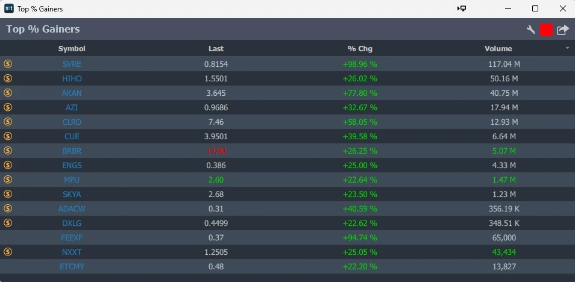

Source: Stocks To Trade
There are always stocks, okay? But that doesn’t mean they’re all worthy of adding to my watchlist.
So, what do I look for other than the percent gain?
Let’s look at one example from my watchlist.
Heigh-Ho, HIHO, It’s Off to Work We Go
Here’s what I look for when deciding whether to add a stock to my watchlist…
What’s the volume?
Highway Holdings Limited (HIHO) caught my attention for two reasons:
1. It was near the top in volume.
2. I knew it had spiked on Monday and held most of its gains on Tuesday:
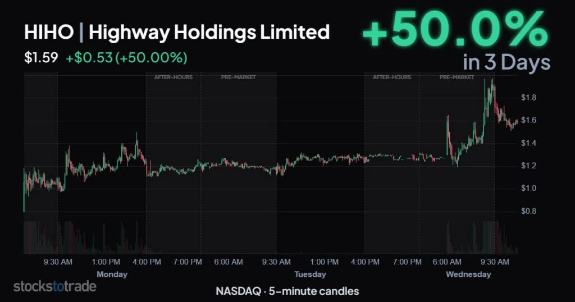

Source: Stocks To Trade
HIHO 11/16/26 – 11/18/26, 5-min candles, special dividend + earnings winner.
Is there news?
Sometimes a big percent gainer looks overextended (with no news).
But HIHO did have news:
• Monday’s spike was the result of a special dividend after a recent takeover deal.
• Wednesday, the company reported positive earnings before the open.
Is it a former runner or supernova?
I tend to remember former runners. But I still zoom out to a long-term chart to check. Here’s the HIHO 1-year chart:
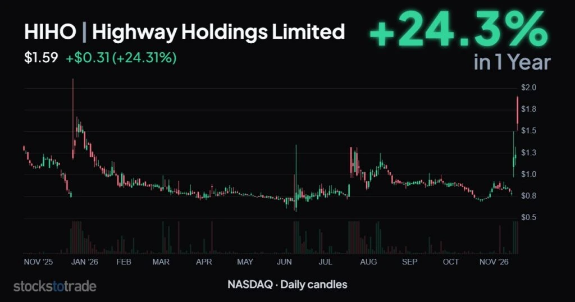
Source: Stocks To Trade
HIHO 1-year, daily candles, former spiker.
HIHO has spiked in the past year. That’s a positive.
Is it a chat pump?
I don’t even know how many chat rooms and websites there are these days. I’ll spare you from the craziness.
But understand that I look for why a stock is spiking so much right now.
If a stock is getting hyped up by chat rooms, like HIHO was, I don’t want to chase it. But I can still put it on my watchlist.
Is it ONLY running on hype?
Is there any other reason, any catalyst I’ve missed, that explains why the stock is moving?
I don’t spend a lot of time on this, but I also don’t want to miss anything obvious like an SEC filing or contract news.
With HIHO, I found the press release about the takeover:
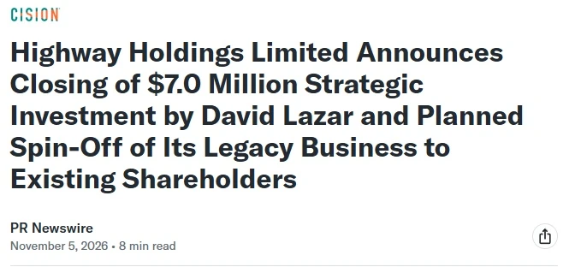

Source: PRNewswire via Yahoo! Finance
That led me to an SEC filing, which told more of the story. (See below: Are there red flags?)
What is the float?
Low-float stocks tend to be more volatile. I like the volatility. It’s exactly what I’m looking for. So, if the float is too big, I usually pass on it.
At more than 2.95 million shares, HIHO is a low-float stock. Any significant volume can spike the stock and rotate the float.
How is it trading in relation to VWAP?
VWAP is important because it lets you know whether buyers or sellers are in control.
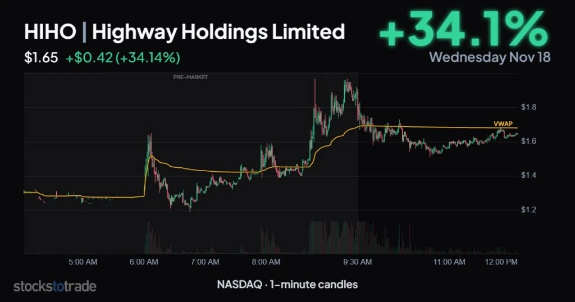
Source: Stocks To Trade
HIHO 11/18/26, 1-min candles, VWAP
If a stock gets too far above VWAP, I won’t chase it (that’s scary). If it comes back down to VWAP and holds, it’s a potential dip buy.
What are the key levels?
Even if I don’t write them down, I call them out to myself.
Some traders draw lines on their charts (or set alerts). Here’s a super quick example using HIHO:
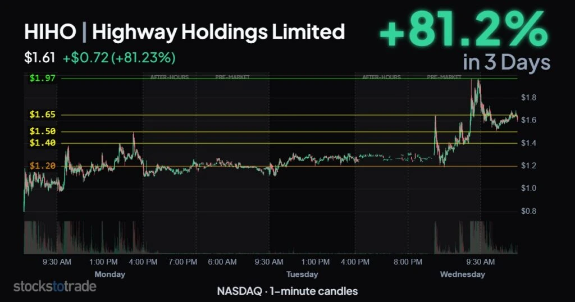
Source: Stocks To Trade
HIHO 11/13/26 – 11/16/26, 1-min candles, quick and dirty key levels.
However you do it, know the key levels of the stocks on your daily watchlist.
Are there red flags?
Is the company scheduled to do a reverse stock split? Is there an offering just waiting to be executed?
With HIHO, there’s dilution risk based on the preferred share structure due to the takeover.
Also, you have to try to avoid the no-rhyme-or-reason action in these plays (it happens a lot).
The bottom line is, as you build your watchlist, it helps you…
Go Into Every Trade With a Plan
Building my watchlist actually helps me form trade plans.
I’m not even going in with my money at this point, okay? I’m just watching.
I know the catalyst (if there is one). I can see when it first started running and how it has traded.
I go through the mental game covered in my Sykes Sliding Scale (even though it’s second nature now).
And, quite often, I watch how the stock is moving.
I go through this process every day to find the best opportunities.
I do all of the above steps very quickly (no more than a few minutes per stock).
But it also stops me from emotional trading.
You don’t want to chase. That’s the biggest takeaway. I would rather miss a play than chase.
I know these crazy plays scare a lot of people away.
For me, it’s the opposite. I have a patience problem. I’m scared of a lack of volatility.
“But, Tim, aren’t you scared?”
Yes, I am scared. I trade scared (and I think it’s a good way to be).
Stay safe, have a plan and build your watchlist every single day.
If you have any questions, email me at SykesDaily@BanyanHill.com.
Cheers,

Tim Sykes
Editor, Tim Sykes Daily
