



Do poker players make better traders?
I constantly say I want dedicated students, not degenerate gamblers…
But as it turns out, traders can learn a lot from the poker mindset — even if they never intend on actually playing cards. It’s similar to channeling the athlete mindset…
Then again, I’m not a poker player, so how do I know this?
Because I’ve found a pattern among several of my top students…
Before they were in the penny stock game, some were in the poker game.
Some of them started with cards and moved on to trading. One of these traders even funded his trading account through poker. Some still play to this day…
What’s up with the trading-poker connection, and how can other traders learn from it to improve their mindset?
Let’s explore…
Poker-to-Trading Pivots: Surprisingly Common…
When something happens once, it’s random. Twice, it’s a coincidence. But when it happens over and over, it’s a pattern.
You know I’m all about patterns when it comes to trading.
But I’m also interested in patterns that potentially lead to trading success. So when I started to notice that several of my students had a history of playing poker, I got interested.
As it turns out, I have at least four students with a background in poker. And all of them are killing it…
Tim Grittani: From $9,000 Gambling Losses to Pro Trader
Most people know Tim Grittani as my multimillionaire student.
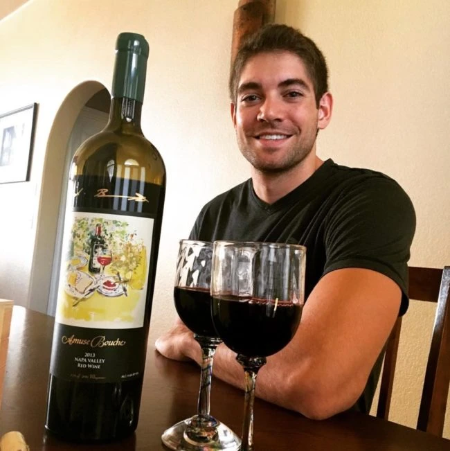

If you’re not familiar with his story, get up to speed — and get inspired — by checking out this post.
Here’s the quick version … Grittani started trading with $1,500. He wasn’t profitable for his first nine months.
But he stuck with it — and he got serious about his education and tracking his trades. Gradually, things started to change for him.
Grittani joined me in 2011. By 2013, he’d made his first million. As of July 2021, he has over $13.5 million in trading profits.
Great story, right? But here’s what you don’t know…
Before Grittani was a millionaire — or a trader at all — he was a poker player.
In college, he looked for easy ways to make money … He found it hard to resist the lure of fast money that gambling promised.
He did it all, from poker to sports betting.
Actually, he even got lucky and made $9,000 on a sports bet. But he eventually lost all his earnings on bad bets.
Losses like that can leave a big impression. It led Grittani to realize he wanted to pursue a path where he could have more of an edge.
Ultimately, his gambling losses helped point him in the direction of what would become one of the greatest passions of his life: trading.
Stephen Johnson: From Scrutinizing Players to Studying Charts
When Stephen Johnson started trading, he definitely fell into degenerate trader territory.
But a few years and lessons from some big losses have taught him well. He went from having to be physically restrained from overtrading to being a disciplined, data-monitoring machine.
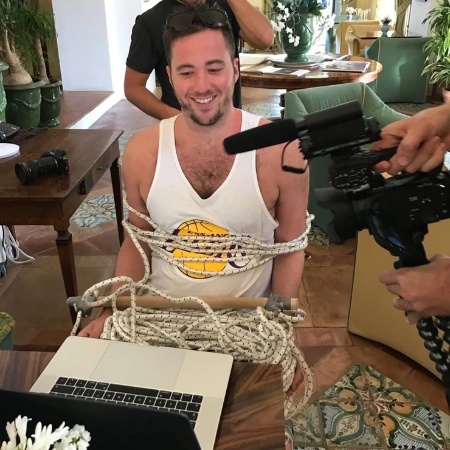

Source: 2026 Millionaire Media, LLC
Like Grittani, he also has a poker-playing past.
Stephen started playing poker in his native England. He says he quickly found an edge by becoming an observer — not just of the game but also of the players.
In tournaments, he saw that a lot of players played very loose, without a real strategy. They were just having fun.
Fine for them, but Stephen wanted to win. So he devised a disciplined, tight method of playing.
Like in trading, aiming for singles in poker wasn’t as fun as trying for home runs. But it was far more reliable than bleeding chips. He began winning about 70% of the time.
He didn’t know it then, but his strategy and power of observation would ultimately serve him well as a trader.
Fast-forward a few years … Stephen was living and working in Dubai and at an impasse in life. He’d just had a bad breakup. He didn’t like his job.
That’s when he found me.
He was wary at first.
But he figured that if he’d been good at poker, he’d probably be decent at day trading. So why not give it a try?
Stephen also thought if I were a scam, he’d expose me … And if not, he might just become wildly successful. To him, both options seemed gratifying.
Did his poker past guarantee instant success? No.
But once Stephen was able to apply the same sort of discipline he’d used in poker, he started to find his trading stride.
Dan: Poker-Powered Trading
Dan pursued poker and trading concurrently — and saw plenty of parallels along the way.


He got into trading at a low point in his life. Dan wanted to find new opportunities … and he found me on YouTube.
But he went in too big, too fast. He started by depositing $30,000 into a margin account so he could be over the PDT rule (soon gone).
Then he made the mistake of thinking he wouldn’t lose. He was wrong.
All traders lose sometimes. Between chasing losses and taking unnecessary risks, he quickly lost $12,000.
He then switched to paper trading for eight months so he could learn the ropes before he scaled back in with real positions.
Like with trading, Dan tried to start too big, too fast with poker.
He says, “I lost $1,000 playing random games with $25–$100 buy-ins that I had no business being in … I had no experience playing poker and didn’t know what I was doing.”
Dan realized pretty fast he’d have to scale back his strategy.
He switched to tournaments with low $3 buy-ins, controlling his risk and gaining experience. That allowed him to learn the game and improve.
As he began to develop patience and adjust to the game, he was able to get more aggressive.
He slowly scaled up to $5 buy-ins, then $10, and scaled up to the higher-stakes games.
As he tells me, “Before moving up in stakes, I made sure to win at least 100 buy-ins to prove to myself I had a real edge over many hundreds, if not thousands, of games.”
In both trading and poker, Dan found that a more gradual approach allowed him to learn the rules. That helped him make smarter decisions.
It’s a powerful lesson that has served him well.
John: From Gambler to Day Trading Dad
These days, John is an accomplished trader.
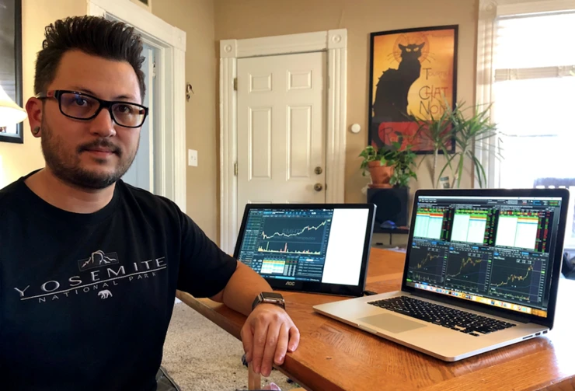

And like the others in the post, before John was a day trader, he was a gambler.
He started with online poker. Then, when the rules changed, John switched to counting cards at blackjack.
He found some success. But after his son was born, he wanted to pursue something closer to home.
John found me — and an interest in trading.
He jumped into trading right away. He made some quick money … but it was a fluke. He went on to lose $16,000 over the next six months.
But then he remembered what had helped him in poker: finding an edge.
So, he started to get serious about his trading education. He started tracking his setups in a spreadsheet to see where he was making money.
About 11 months into his trading, he was in the green.
But he admits it wasn’t easy. “It was much easier for me to be disciplined and do the right thing with poker. I’ve tried to contemplate the parallels to help with my trading discipline.”
He initially found his edge with OTC stock breakouts, and he’s continued to adapt since.
Does Poker Give Traders an Edge?
Poker-to-trading pivots aren’t unusual … But does a poker-playing past give traders an edge?
Every one of the traders featured in this post says poker helped speed up their learning curve and achieve the right mindset in trading.
But does that mean that all traders should play poker? Not necessarily.
Come back tomorrow and I’ll share the important lessons that traders like you can take away from having a poker mindset.
If you have any questions, email me at SykesDaily@BanyanHill.com.
Cheers,

Tim Sykes
Editor, Tim Sykes Daily
