



No one takes a road trip without directions or, at the very least, a map.
But that’s what you do when you trade without a chart pattern.
Chart patterns are the very foundation of what I teach and how I, and many of my millionaire students, trade.
By now, most of you have heard about one of my favorite patterns — supernovas.
A supernova is a massive, explosive trading pattern where a low-priced stock can SOAR 100%, 500%, or even 2,000% fast.
This was the first pattern I came across that totally changed my life.
Now, I want to let you in on a little secret.
Chart patterns are about more than just visuals. It’s about the narrative they tell.
When I look at a chart pattern, I don’t just see numbers. I see a novel written about the transactions between buyers and sellers.
One of my top millionaire students, Mark Crook, had a supernova analysis that was so spot-on I had to share it with you.
I’ll explain his trade in BrightMinds Biosciences Inc. (DRUG) and, more importantly, WHY he took it.
My 7-Step Framework
It’s crazy how many supernovas we’ve seen so far this year.
If it plays out like I think it will, we’re going to see even more supernovas.
To spot them, first you need to understand my 7-step framework…
Step #1: The Pre-Pump or Promotion
At step #1, you can make big gains, but it takes time.
The goal is to predict the huge spike ahead of time, regardless of the reason. This step is best for patient people with small accounts.
That said, it’s difficult to guess on plays like this. It’s tough without experience. Especially since the old-school email and mailer promotions pretty much died.
Step #2: Ramp
In step #2, the run-up speeds up. There’s consolidation in anticipation of a breakout. Ideally, there’s sideways action and then a technical breakout. There’s often increased volume and more hype.
Back in the day, the hype came on message boards and emails. These days, it’s done by Twitter pumps and in chat rooms.
Tip: Promoters use dozens, if not hundreds, of bot accounts on social media. Ride the hype, but don’t believe the BS. You’ve been warned.
When a stock is ramping, it’s possible to buy and hold for a few days or weeks. But again, you’re basically guessing that the promotion will work.
Step #3: Supernova
This is how I made my first $1 million back in 1999 and 2000.
And to be honest, I didn’t understand what was happening. I just recognized the pattern and rode the wave. I bought the breakouts.
This is the most rewarding time to be long. But it’s also the riskiest. You MUST be aware that the higher a supernova goes, the more overextended it gets. Be very cautious with buying overextended stocks.
It all comes down to experience and practice. When you’re wrong (and you will be sometimes), always follow rule #1: cut losses quickly.
How long do you hold a supernova? That depends on a lot of things. Is the big move happening in one day? Or is it over multiple days? How many days has the stock been green?
You have to consider many factors.
I recommend learning the first green day pattern. And be willing to adapt.
Remember, supernovas can flip on a dime.
Step #4: Cliff Dive
You know the old adage … What goes up must come down.
The 7-step penny stock framework came from observing price action on penny stock pumps.
Back in the day, once a promotion stopped, the bottom fell out. Stocks sometimes dropped 50% or more in a day.
Fast-forward to today. Stock promoters might not use the same tools, but they still pump stocks.
And when the promotion stops, the bottom still falls out. A small decline near the top turns into a full-on collapse.
This is the best time to short sell promotions. But it’s also usually the most difficult time to find shares to short. Why?
When a stock goes from $0.50 to $5 over a few days, short sellers start circling like vultures. Especially if it’s based on promotion and hype.
We’ve seen many sub-penny plays go full supernova recently. So they might get up to $0.10, $0.20 or even $0.50 a share.
So before we get to step #5, there are two MAJOR caveats…
First, I think shorting is a flawed strategy right now. There are too many overaggressive newbie shorts in the market. It’s a risky strategy in a crowded space.
Second, I’d NEVER short an ultra-low-priced play. Even when I was short-biased, I rarely shorted anything below $1. There had to be a good reason and/or proof of a pump.
But that’s OK because I’ve learned to adapt by playing…
Step #5: Dip Buy
The panic dip buy is my favorite pattern for small accounts.
For me, this is the best time to buy a promoted stock. There’s still momentum and interest. The promoters tell their followers to hold, but a lot of newbies set hard stop-loss orders.
When the stop losses get taken out, it becomes a self-fulfilling prophecy.
Often there’s a solid bounce for one or more of these reasons, depending on the stock’s price…
Dip buyers are waiting for the turn.
Short sellers buy to cover. Again, no big-time short seller is gonna short sub-penny stocks. Most won’t touch anything below $0.50 a share. The risk is too high.
Promoters try to create a soft landing so they don’t get investigated.
A stock can run 50% or more in a few hours or days. Sometimes the bounce happens in under an hour.
That means preparation is key.
Again, sometimes the panic bounces, and sometimes it doesn’t. Don’t get stubborn. When in doubt, follow rule #1 and get out.
Be aware that the market ebbs and flows. Sometimes bounces work well. Other times, there are fakeouts and outright failures.
Learn to avoid these three common mistakes when dipping too early.
Remember, you MUST adapt.
Step #6: The Dead Pump Bounce
When I was short biased, this was my favorite time to short. Again, when a stock goes supernova, short sellers want to short it.
But that’s risky because you have no idea how high it can go.
Once the stock has had a cliff dive and a bounce, short selling can be a little more predictable.
That said, there’s not as much range. So while it’s easier to find shares to short, you’re not as likely to get a big percent win.
Also … we’ve seen plays with two or more big spikes recently. Sometimes the bounces go right back to highs. Sometimes there’s no bounce at all.
Bounce or not, the next step is…
Step #7: The Long Kiss Goodnight
Penny stock pumps don’t end with the company changing the world with its amazing product. They’re all junk.
And that’s why step #7 happens. It’s a gradual decline over days, weeks, or months.
Do You Supernova?
Now, back to Mark and his DRUG trade…
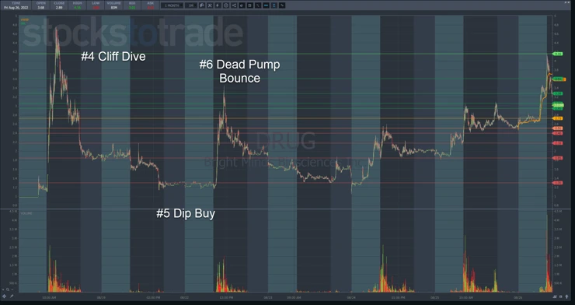
Within that framework, most people probably expected the stock to fall into #7, the long kiss goodnight, after the second spike that made a lower high (#6).

Source: Stocks To Trade
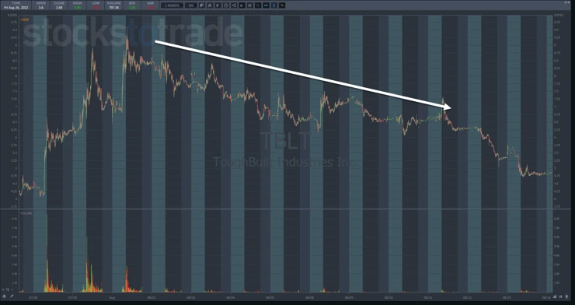
Normally, a stock gets to that point and fades into oblivion with some bounces here and there along the way.
Those small bounces are great plays for dip buys.
However, this stock did something very different.
You see, normally, stocks do something like this…
Source: Stocks To Trade
…where they bounce now and then but slowly fade into oblivion.
Instead of taking this typical path, DRUG held the $1.30 low from the dip buy on light volume.
But slowly, shares began to climb as volume increased.
Over the next two days, DRUG popped and consolidated to form a bullish formation.
Think about that for a moment.
A stock that’s had a tremendous run found support on light volume.
To me, that says there were few, if any, sellers at that spot.
Once buyers became more aggressive, shares began to rise.
Although there was evidence the stock wanted to make another push after the first push, the second day’s push solidified this notion.
At that point, it makes all the sense in the world to look for a move through the highs at $3.40 from the dead pump bounce.
The key was not the lower highs but the higher lows. That narrowed the trading range, creating the elements necessary to squeeze higher.
And when the stock began to make a higher high, the writing was on the wall.
Mark took a small trade, entering somewhere around $2.70 and exiting part of the trade at around $3.
However, the story told by the pattern here is what’s important.
Consolidation patterns by themselves are meaningless without context.
For example, the dead pump bounce created a bullish consolidation that failed.
Why didn’t the one that came after that?
It all comes down to where they occurred in the 7-step framework and the associated price action.
That first bounce is typical after a stock goes supernova.
The resurgence on heavy volume after that is unusual and more indicative of a spike in a previous runner that we see weeks to months down the road.
Nonetheless, the price action says what it says.
Higher lows and higher highs on heavy trading speak volumes.
Spend time learning your chart patterns. But, don’t just look for the obvious ones. Study the failures and the unusual ones like DRUG.
Look at the price action and ask yourself: what’s it trying to tell me right here?
And when you’re ready, trade the patterns.
What do you think of the 7-step trading framework? Let me know at SykesDaily@BanyanHill.com. I’d LOVE to hear from you!
Cheers,

Tim Sykes
Editor, Tim Sykes Daily
