



Millions of dollars change hands every day right now. All from seemingly insignificant news.
In today’s market, a few simple words can lead to incredible gains for your account.
I’m not talking about the Fed’s interest rate decision, or updated comments about inflation…
Last Thanksgiving, during the annual presidential turkey pardon, a 26-year-old ex-CPA bet “no” for the words “stuffing” and “cheaper” in the prediction markets.
As told by The New York Times, from his betting station in a NYC apartment, he then found an early tip from Associated Press that confirmed Trump would pardon the turkey named “Gobble” rather than “Waddle.”
Multiple wins from an otherwise unassuming yearly tradition.
Welcome to prediction markets. The newest and most electric style of “trading.”
I remember when cryptocurrency was the breakout sector all over the news. And don’t forget about NFTs. Who could forget the Bored Apes?
The two biggest prediction markets right now, Kalshi and Polymarket, topped $10 billion of monthly volume in November 2025. Which implies $300 million per day on average for that month.
The New York snowstorm in January 2026 boasted a volume over $5 million on one Kalshi weather contract.
This is big-time money.
And some of the bettors are cashing out in a big way.
Major businesses are starting to take notice too. Google and Yahoo Finance now both offer prediction market data.
It’s the equivalent of making a secret side bet with your buddy, but now you can bet on almost anything in the world, at any time, with anyone who’ll take your bet.
• How is this legal?
• How does it work?
• Should I get involved?
Those were my thoughts exactly.
The Prediction Market
In the U.S., prediction markets can operate as “federally regulated derivatives exchanges” listing “event contracts” under the Commodity Exchange Act.
These markets are overseen by the CFTC (the same regulator that supervises futures).
Gambling services like sportsbooks are licensed state-by-state, specifically as gambling operations.
Whereas event-contract exchanges are federal financial markets with prospectus-like rulebooks (called “rule filings”) and strict resolution criteria for how outcomes settle.
These federally regulated exchanges operate nationwide, but user access can still vary by state. Some states impose their own restrictions or enforcement priorities. Especially for certain product categories, like elections or sports-adjacent contracts.
In short, this is all 100% legal. And at least for the time being, it lends itself to insider trading.
Look at the headline below:
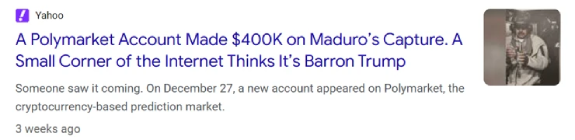

There was also talk of a press conference with Press Secretary Karoline Leavitt that ended abruptly, coinciding with a bet on Polymarket that concerned the length of the conference.
There’s already a bill proposed to ban federal officials from prediction markets.
But the markets operate across all areas of life. Anyone involved in any of these bets has an opportunity to get in before the results are announced for the general public.
We’re talking about sectors like:
• Politics & policy
• Economics
• Weather & natural events
• Sports-adjacent
• Business & markets
• Entertainment & culture
• Public health & science
• Digital trends
The list is endless, as long as it has a clear and measurable outcome by a certain date.
Should We Get Involved?
There’s a lot of money moving in this new market. And there’s a lot at stake.
In the story I read from The New York Times, the traders they followed spent most of their time online. They would research trends, look through history for data to support their position, and the best traders seemed to make a lot of money.
But I have an issue with this new market.
Yes, at face value, it sounds like the life of a stock trader.
• The screen time.
• The hours spent studying.
• The success of the most dedicated.
I take issue with the hours spent studying…
Studying what?
In the story from The New York Times, the trader went through past Trump turkey pardons to see what kinds of words he included in those speeches.
That doesn’t satisfy me.
There isn’t a discernible pattern to follow for success in the prediction market.
The stock market is based on company value. Profits and losses. Sometimes hype and speculation, but it always comes back to the money.
That makes it measurable. That allows us to build sample sizes of data over months and years to give ourselves better and better odds on the same setups that occur over and over again.
But There’s a Caveat…
Considering the nature of the prediction markets, the only time I’d support a trade is if you definitely had information that others didn’t.
Like if you were Barron Trump or one of the Delta Force soldiers on your way to pick up Maduro.
Otherwise, it’s not worth the time and energy. In The New York Times story, a trader said he spent 16 hours a day online.
That’s not healthy.
I tell all my students to study hard, but to reserve time to rest, recoup, and live life.
We get into trading to live more freely. Not to slave away in front of a screen.
Prediction market traders spend too much time online trying to defend their position because at their core, they know: There is no pattern to follow.
It’s a really interesting corner of the market. But you won’t catch me trading it.
I stick to the same stock trading process that’s made me millions since I started over two decades ago.
The same process that my millionaire students use.
These patterns repeat over and over again.
You should follow them too.
Or you can lose sleep over a Polymarket bet about who’ll win Song of the Year for the Grammys…
Your choice.
If you have any questions, email me at SykesDaily@BanyanHill.com.
Cheers,

Tim Sykes
Editor, Tim Sykes Daily
