


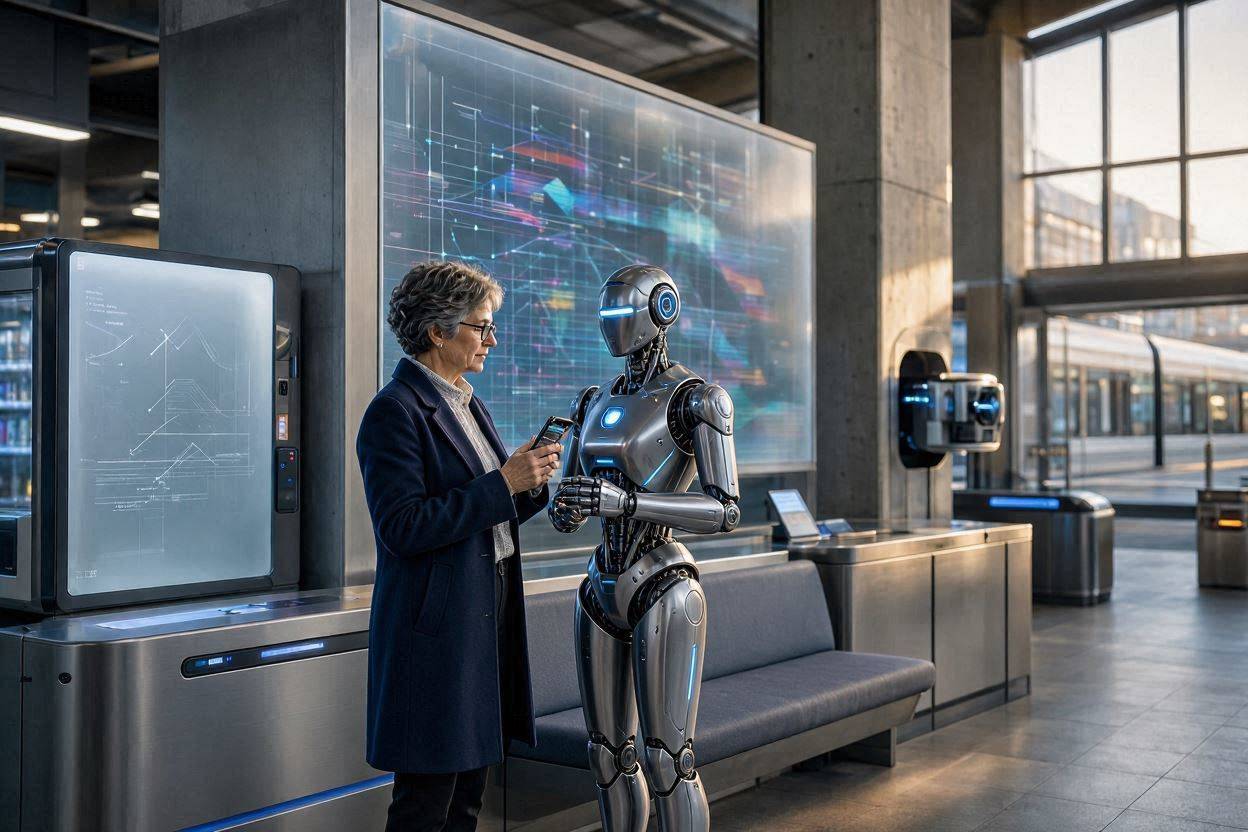
I recently wrote about how today’s AI companies are teaching artificial intelligence to behave.
Instead of simply making AI smarter, researchers are trying to teach it what’s helpful, what’s harmful and when it should refuse a request.
That article sparked a bunch of thoughtful emails from Daily Disruptor readers.
Rosemary wondered “why we hear little, if anything, about Asimov’s Three Laws of Robotics” as humanoid robots become more common.
She asked how robots could be taught “at least a basic common morality” and, perhaps more importantly: “How would they be prevented from deleting that programming from themselves or other robots?”
Barbara also said my recent articles reminded her of “a very old science fiction book” by Isaac Asimov, where “the primary code in the robots was that they would never be able to harm a human under any circumstances other than to save the life of one it was tasked with protecting.”
It’s no coincidence that both readers referenced the same author.
More than 80 years after Asimov introduced his Three Laws of Robotics — featured in the Will Smith movie I, Robot — they’re still the first thing many people think about when it comes to intelligent machines.
And today’s AI companies have been wrestling with many of the same questions Asimov brought up in his books.
But they’ve discovered that what works in fiction doesn’t necessarily work in the real world.
The Problem With Asmiov’s Rules
Isaac Asimov introduced his famous Three Laws of Robotics in a 1942 short story.
On paper, they sound almost foolproof.
- A robot may never harm a human being.
- It must obey human instructions unless doing so would harm someone.
- And it must protect itself unless that conflicts with the first two laws.
But Asimov didn’t spend the next 40 years writing stories about robots peacefully following these rules.
He spent them showing how they could break down.
That’s because once a machine has to make decisions in the real world, simple rules stop being simple.
For example, suppose an elderly person falls and tells a household robot not to call for help.


Should the robot obey? Or should it ignore those instructions because waiting could put that person’s life at greater risk?
Now imagine a child running into traffic.
Should the robot tackle the child, knowing that knocking someone to the ground could cause them harm, but allowing them to continue could be much worse?
Suddenly, “don’t harm humans” becomes less of a rule and more of a judgment call.
That’s exactly why today’s AI and robotics companies aren’t trying to recreate Asimov’s Three Laws. Because they’ve concluded that no single set of rules can anticipate every situation an intelligent machine might encounter.
Instead, they’re building multiple layers of protection, each designed to catch a different kind of failure.
Google DeepMind is one of the clearest examples.


Image: Google
When it unveiled Gemini Robotics earlier this year, the company described its safety strategy as three separate layers: semantic safety, physical safety and operational safety.
Like Asimov’s rules, each one tackles a different problem.
Semantic safety is where the AI attempts to understand whether an action itself could be dangerous.
For example, a humanoid robot should recognize the difference between handing someone a kitchen knife and using that same knife as a weapon.
That seems obvious to us, but engineers have to teach machines how to recognize intent, context and competing priorities. That’s an incredibly difficult challenge because the same action can be perfectly appropriate in one situation and completely unacceptable in another.
It’s one reason companies like Anthropic developed techniques like Constitutional AI, where models evaluate their own responses against a written set of ethical principles before producing an answer.
But Google doesn’t stop with the AI mind. Engineers also limit what the robot can physically do.
That’s the physical safety layer.
Engineers can’t assume AI will always make the correct decision, so they’re designing hardware that reduces the consequences if it doesn’t.
For example, a robot’s joints could automatically slow when people are nearby. Or its grip strength could be limited, and collision sensors could stop its arms before it strikes someone.
In other words, the robot’s body becomes part of the safety system.
Finally, there’s operational safety.
This governs where a robot can work, what tools it can access and whether certain actions require human approval.
Clearly, a robot working in a warehouse shouldn’t automatically have access to every piece of industrial equipment. And a household robot might need to refuse to enter certain areas of a home without permission.
Again, this philosophy is completely different from Asimov’s.
And it extends well beyond Google.
Figure AI’s newest humanoid robot includes multiple layers of protection around something as mundane as its battery system, with safeguards built into the battery cells, the battery pack and the software managing both.


Image: figure.ai
Even international robot safety standards don’t use abstract ideas like “never harm a human.” They focus on practical engineering, like emergency stop systems, protective sensors and human oversight.
The goal is to build machines that remain safe even when something goes wrong.
That’s not nearly as cinematic as Asimov’s Three Laws, but it’s much closer to how we design airplanes, elevators and automobiles.
Here’s My Take
The biggest lesson from Isaac Asimov’s writing is that three simple laws can’t keep intelligent machines under control.
As robots become more capable and begin working alongside us in hospitals, factories and eventually our homes, safety will depend on building multiple layers of protection that work together.
But that still leaves Rosemary’s second question.
What prevents an intelligent machine from bypassing the very safeguards we built to keep it safe?
Tomorrow, I’ll explain why this is fast becoming one of AI’s most important questions.
Regards,

Ian King
Chief Strategist, Banyan Hill Publishing

Editor’s Note: We’d love to hear from you!
If you want to share your thoughts or suggestions about the Daily Disruptor, or if there are any specific topics you’d like us to cover, just send an email to dailydisruptor@banyanhill.com.
Don’t worry, we won’t reveal your full name in the event we publish a response. So feel free to comment away!