


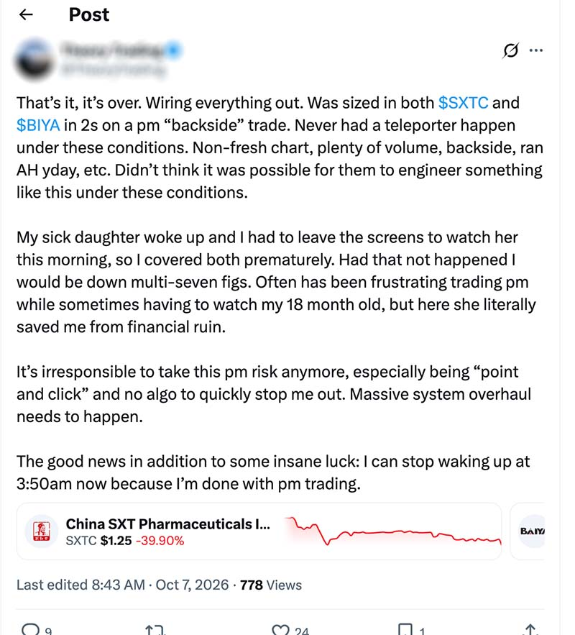
Yesterday, a well-known short seller posted this on his X account…
“That’s it, it’s over. Wiring everything out. […] It’s irresponsible to take this pm risk anymore, especially being ‘point and click’ and no algo to quickly stop me out.”
Will he REALLY quit short-selling in premarket?
For his sake, I hope so.
This is why I ONLY go long. It’s also a lesson for the ages…
It was INSANE…
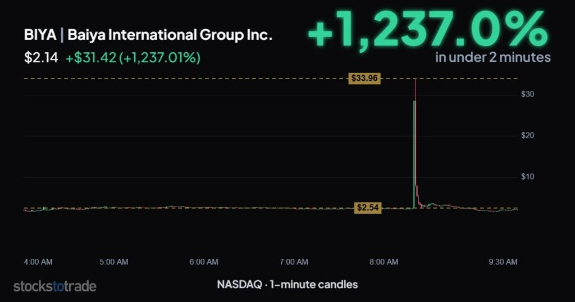
Baiya International Group Inc. (BIYA) spiked 1,237% in under two minutes!
How does that even happen?
Understand that BIYA looks like a typical China scam stock.
These are small, China-based companies that list on the Nasdaq. Then, coordinated pump-and-dump schemes scam people out of their savings.
Frankly, it’s disgusting.
Regardless of what anyone thinks about these stocks, they create opportunities.
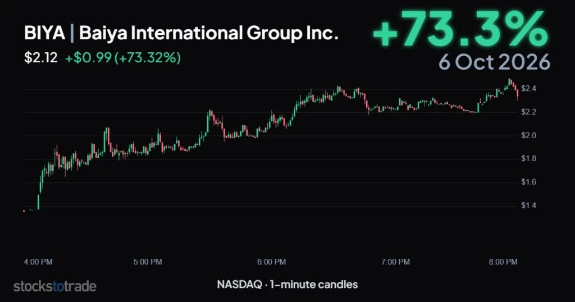
For example, on Tuesday, BIYA ran in after-hours trading.
The After-Hours Setup That Sucks In Short Sellers
Here’s the BIYA after-hours chart…

Source: Stocks To Trade
BIYA 10/6/26 after-hours, 1-minute candles.
Congratulations to all longs on a beautiful trade.
Now, imagine what it’s like to be a short-seller when you see that stock.
Here’s what every short seller was thinking…
• It’s a scam company.
• It shouldn’t be up 73% in a few hours.
• It’s going to zero.
• All I have to do is get in on the backside and I’m going to crush it.
It’s not that short sellers are wrong, but they take a MASSIVE risk by being overaggressive.
Especially with a low-float stock that brings short sellers to their knees with an algo-driven liquidity sweep.
When I see something like this, it sends cold chills down my spine…
Source: Stocks To Trade
BIYA 10/7/26 premarket only, 1-minute candles.
Is that CRAZY, or what?
There’s a twist to the story, but first, here’s what happened…
BIYA spiked from $2.54 to $33.96 in under two minutes. Within five minutes, it came all the way back down.
Here’s what led to this crazy move…
• After doing a 1-for-10 reverse stock split in July, BIYA is a micro-float stock (~1.4M publicly traded shares).
• The after-hours run on October 6 attracted short sellers.
• Retail shorts were forced to cover after what was most likely an algo-triggered liquidity sweep.
How does a liquidity sweep work?
Proprietary market makers have direct market access.
Their software can trigger algorithmic orders called limit buy sweeps. Essentially, the algo is hunting for short seller stops.
Once the stops (or forced covers) trigger, high-frequency trading (HFT) firms sell into the panic buying.
Short Sellers Got Lucky (THIS Time)
Nasdaq busted any BIYA trades above $3.05 under Rule 11980(b).
The rule gives the exchange the ability to cancel any “clearly erroneous” transactions.
What about the short seller I mentioned earlier?
He was already out (thanks to his sick daughter)…

Source: X
But too many short sellers got caught and probably thought it was the end of their careers.
Understand that most of these companies eventually fail. Again, shorts aren’t wrong.
But I think it’s insane to short penny stocks in this market environment.
I doubt very seriously that I’ll ever short stocks like this again.
Because even if short sellers are right and the stock doesn’t deserve to be up … and even if you manage to get on the backside of the move…
You could get caught in an algorithmic liquidity sweep that turns into a career-ending blowup.
THIS time, short sellers got VERY lucky.
After 25+ years of trading, the stock market never ceases to amaze me.
Short sellers got lucky with BIYA.
The question is, will they learn the lesson?
This WILL happen again and there’s no guarantee that Nasdaq will step in.
So, my question to short sellers is…
Will you learn from this and adapt, or will you continue making the same mistakes over and over again?
If you have any questions, email me at SykesDaily@BanyanHill.com.
Cheers,

Tim Sykes
Editor, Tim Sykes Daily
