



Isn’t it crazy how things change but always stay the same?
On Tuesday, Jaguar Health Inc. (JAGX) ran from $2.80 per share at the open to $65.75 in after-hours trading.
It created a ton of opportunities (and I’m happy for my after-hours win).
But what makes a move like that even possible?
It has nothing to do with JAGX being an investment-worthy stock (it’s not).
As I write, it’s already back down to the $16s.
Whether you traded it or not, it’s good to know why a move like that happens because it’s not the first time (and won’t be the last).
Let’s go inside the big JAGX squeeze…
Reverse Splits and Death Spiral Dilution
First, roughly 50% of businesses fail within 5 years…
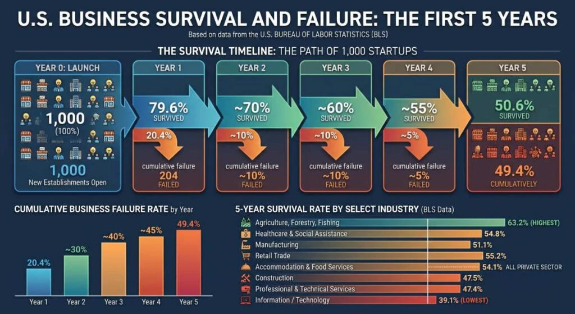

Source: Chart created with Google Gemini using data from U.S. Bureau of Labor Statistics
That’s nothing new, right?
For penny stock companies, I’d guess the long-term failure rate is higher than 90%.
But the difference between a listed company and a private company is…
A listed company can always go to the market to raise cash.
Many of these companies reach a point where the number one thing they do is sell shares to stay alive.
Let’s unpack JAGX, because once you understand how the company stays listed, Tuesday’s squeeze will make more sense.
Let me preface this by saying I have nothing against Jaguar Health, I’m not a short seller and I don’t care whether the company has the next life-changing anti-diarrhea medication for dogs.
This is about what happens when a company has to constantly use reverse splits and dilution to keep the office doors open.
8 Reverse Splits Since 2018
First, a reverse split means that several shares are rolled up into one share.
For example, on September 17, Jaguar Health completed a 1-for-15 reverse split (15 shares became one share).
But the eight reverse splits since 2018 mean… Every share today was 186,046,875,000 shares in 2018.
Let’s round that down to 186 billion to keep it simple.
Keep in mind that there were never 186 billion JAGX shares in the public float.
That’s because every reverse split reduced the share count.
Why would a company do that?
Because Nasdaq listing rules say that a company’s stock must remain above $1 per share.
Now, for a small, struggling company, doing this once or twice might be understandable.
Until the next time the company runs out of cash, that is.
Every time the company needed cash, it issued new shares. And THAT created…
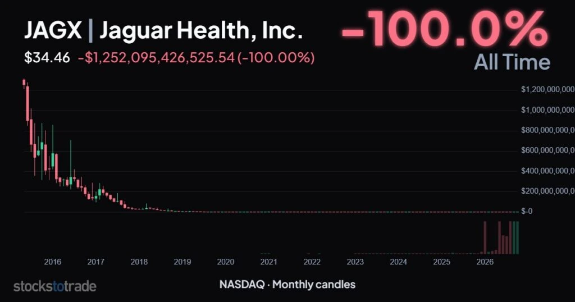
A 64 Trillion Share Dilution Doom Loop
Here’s how it looks…

Source: Stocks To Trade
JAGX, all-time, monthly candles, effective 100% dilution.
And here’s how it works…
Jaguar Health has products and a pipeline, but it obviously isn’t profitable. It’s better at selling hype than drugs.
So, when it runs out of cash, it does an offering. That dilutes shareholders and tanks the stock’s price.
When it drops below the $1 threshold for 30 consecutive business days, the company gets a delisting warning.
That gives them 180 days to get the stock price above $1 for a minimum of 10 consecutive business days.
So, these crap companies, including Jaguar Health, do reverse splits to increase the stock’s price.
And the dilution death spiral goes on…
1. The company needs cash and does an offering.
2. The offering raises cash but dilutes shareholders and drops the stock price.
3. The stock drops below the threshold (and the company gets a delisting warning).
4. The company does a reverse split to raise the price above $1 per share.
5. See step 1 above…
It’s a joke, right? Except it’s not.
So, how did JAGX go from the $2s to $65 in one day?
Remember that last 1-for-15 reverse split? That took the float down to roughly 345K shares.
On Tuesday, the company announced that the FDA waived fees for one human-related and one dog-related diarrhea medication.
That’s good news, right? Are congratulations in order? After-work drinks for the… er… diarrhea researchers?
But with a float of only 345K shares, what do you think happened?
The Big Squeeze
It almost doesn’t matter who or what started the move. The news created a spike, chat rooms got involved, short sellers piled in, the float was tiny…
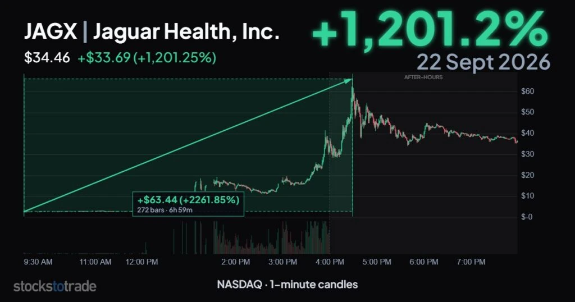
It was the perfect recipe for a highly volatile squeeze. At one point, JAGX was up +2,261% on the day…
Source: Stocks To Trade
JAGX 9/22/26, 1-min candles, BIG squeeze.
And with every skip up, dumb short sellers sacrificed more of their toxic, bitter lemon souls to prove a point.
Which is great news for longs, because the short sellers got absolutely CRUSHED.
My JAGX Trade
When JAGX was squeezing during the day, I posted this…
Awesome awesome awesome run on $JAGX but soooo many halts … can’t wait to trade it after hours where there’s NO HALTS!!!!
I don’t want to trade stocks halting and skipping like that (it’s WAY too stressful).
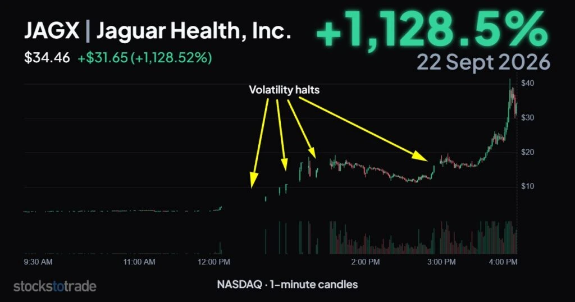
By the end of regular hours, there were even MORE halts…
Source: Stocks To Trade
JAGX, 9/22/26 volatility halt city.
Every gap on the chart during regular trading hours was a halt. That’s NASTY price action.
So, I waited until after-hours when there were no volatility halts.
Within 20 minutes of that tweet, JAGX…
Squeezed overaggressive short sellers to the $41s BEFORE the regular market even closed!
So, my trade ended up being an after-hours dip buy. And it was moving so fast I had to pay up a little…
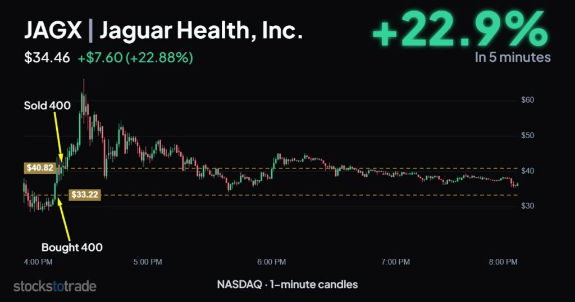
Source: Stocks To Trade
JAGX, 9/22/26, after-hours, 1-min candles, dip buy.
Still, I’ll take 23% in 5 minutes any day of the week.
Thank you, short sellers, for your sacrifice!
Key Takeaway
Nothing I’ve described here is new.
Penny stock companies have been using death spiral dilution for as long as I can remember.
The key lesson is that regardless of the reason, you can trade the patterns and do well.
Just be sure to sell into strength and cut losses quickly.
With a big squeeze like JAGX, I personally avoid regular-hours trading because the halts are scary.
Instead, I suggest waiting until after-hours when the price action is easier to follow.
If you have any questions, email me at SykesDaily@BanyanHill.com.
Cheers,

Tim Sykes
Editor, Tim Sykes Daily
