


Most companies go to great lengths to keep their technology away from competitors.
But Vulcan Robotics is taking the opposite approach.
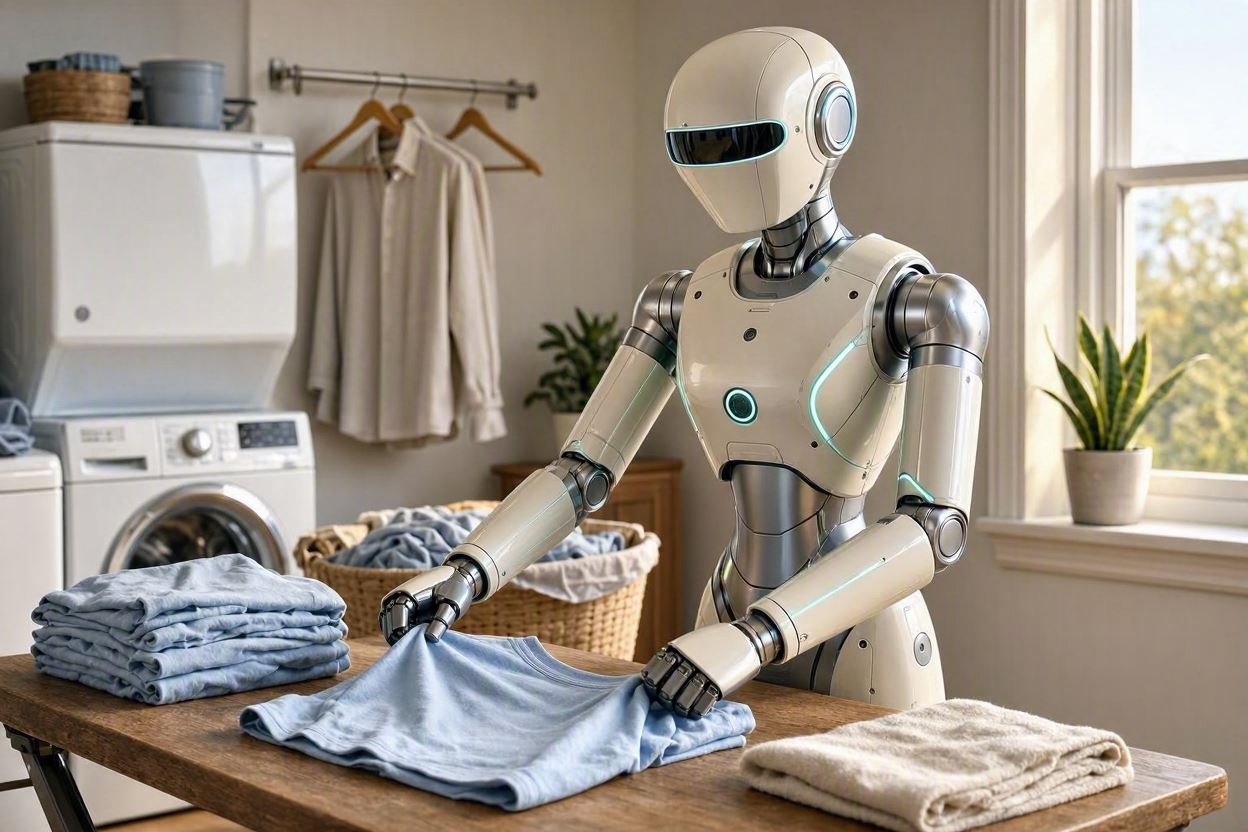
The company has built a robot that can fold laundry, set a table and clean up around the house. But instead of keeping its design under wraps, it plans to make the blueprints available to everyone.
After all, the fastest way to build the robots of the future might be to stop building them behind closed doors.
Meet Sourccey
Vulcan Robotics’ new robot is called Sourccey. It stands roughly 40 inches tall, rolls on four wheels and has two arms that can handle everyday objects.


Image: Vulcan Robotics
But the most interesting thing about Sourccey isn’t what it can do already.
It’s what other people could teach it to do.
You see, Vulcan plans to make Sourccey fully open source. That includes its mechanical designs, electrical plans, software and AI models.
Developers will be able to download the plans, study how the robot works and modify it for their own projects. If they find a better way to control its arms or teach it a new skill, they can share those improvements with everyone else.
That makes Sourccey very different from most of the robots we’ve discussed here in the Daily Disruptor.
Tesla isn’t publishing the blueprints for its Optimus robots. Boston Dynamics isn’t inviting developers to print replacement Atlas parts in their garages. And Figure AI has raised billions to develop technology it hopes will set its robots apart.
Vulcan is betting on collaboration instead.
And we already know how powerful that approach can be, since we recently discussed how open-source AI models have helped China narrow America’s AI lead.
Chinese developers don’t always need to spend hundreds of millions of dollars training a model from the ground up. They can start with an existing open model, improve it for a specific purpose and share what they learn.
That’s what Vulcan Robotics intends to do with Sourccey.
It’s also designed to work with LeRobot, an open-source robotics platform created by Hugging Face.


Image: Hugging Face
Hugging Face makes it easier for AI developers to build on one another’s work. LeRobot applies that same approach to robotics. Instead of every developer creating their own tools from scratch, they can use LeRobot to control robots, collect training data and teach them new skills.
And Sourccey gives them a relatively inexpensive robot to experiment with.
For example, a person can remotely control Sourccey’s arms while folding a shirt. As the robot follows those movements, it records video along with the position of its joints. That video becomes training data that can be used to train an AI model, run it on the robot and see whether Sourccey can repeat the task on its own.
If it fails, developers can collect more examples, adjust the model and try again.
Vulcan says Sourccey can now fold a crumpled shirt correctly about 90% of the time, with each attempt taking less than two minutes. The company also plans to release its laundry-folding models and training data after launch.
That gives new developers a leg up.
Instead of spending months building a robot and teaching it the basics, they can start with Sourccey’s existing design and models. One developer could then improve the way it handles sleeves, while another could train it to fold towels. Someone else could teach it to load the clothes into a drawer.
And each improvement becomes another building block for the entire community.
That’s the promise of open-source robotics.
No single company can possibly test a robot in every home, with every object and under every possible condition. But thousands of developers working with compatible hardware can cover far more ground.
And it’s not like Sourccey is built from exotic parts. Its brain is a Raspberry Pi 5, which you can buy online for less than $200.


Image: Raspberry Pi
Its body is largely made from PLA plastic that can be produced on a desktop 3D printer. It uses commercially available cameras and servo motors, and many of its parts are designed to be replaced individually.
It’s essentially a developer’s kit that can fold your laundry.
Which isn’t to say that Sourccey is ready to take over all your chores yet.
Some of its capabilities still depend on remote control, and Vulcan doesn’t expect the robot to reach full autonomy across its core household tasks until 2028.
But it’s still incredibly exciting.
Remember, early personal computers weren’t immediately useful to the average household either. But they put programmable machines into the hands of people who discovered new things to do with them.
Sourccey could play a similar role for physical AI.
Here’s My Take
Vulcan isn’t alone in believing open source could speed up robotics.
Nvidia recently expanded its partnership with Hugging Face to bring its own physical AI models, simulation tools and training systems into LeRobot.
The partnership gives developers a common way to collect robot data, train models, evaluate their performance and deploy them across compatible machines. It also connects Nvidia’s millions of robotics developers with Hugging Face’s much larger community of AI builders.
And that could create a powerful feedback loop.
More accessible robots bring more developers into the market. More developers create more training data and skills. And better skills make the robots more useful, attracting even more developers.
That’s how open-source software transformed computing.
And we’re about to find out if it will do the same with robots.
Regards,

Ian King
Chief Strategist, Banyan Hill Publishing

Editor’s Note: We’d love to hear from you!
If you want to share your thoughts or suggestions about the Daily Disruptor, or if there are any specific topics you’d like us to cover, just send an email to dailydisruptor@banyanhill.com.
Don’t worry, we won’t reveal your full name in the event we publish a response. So feel free to comment away!