


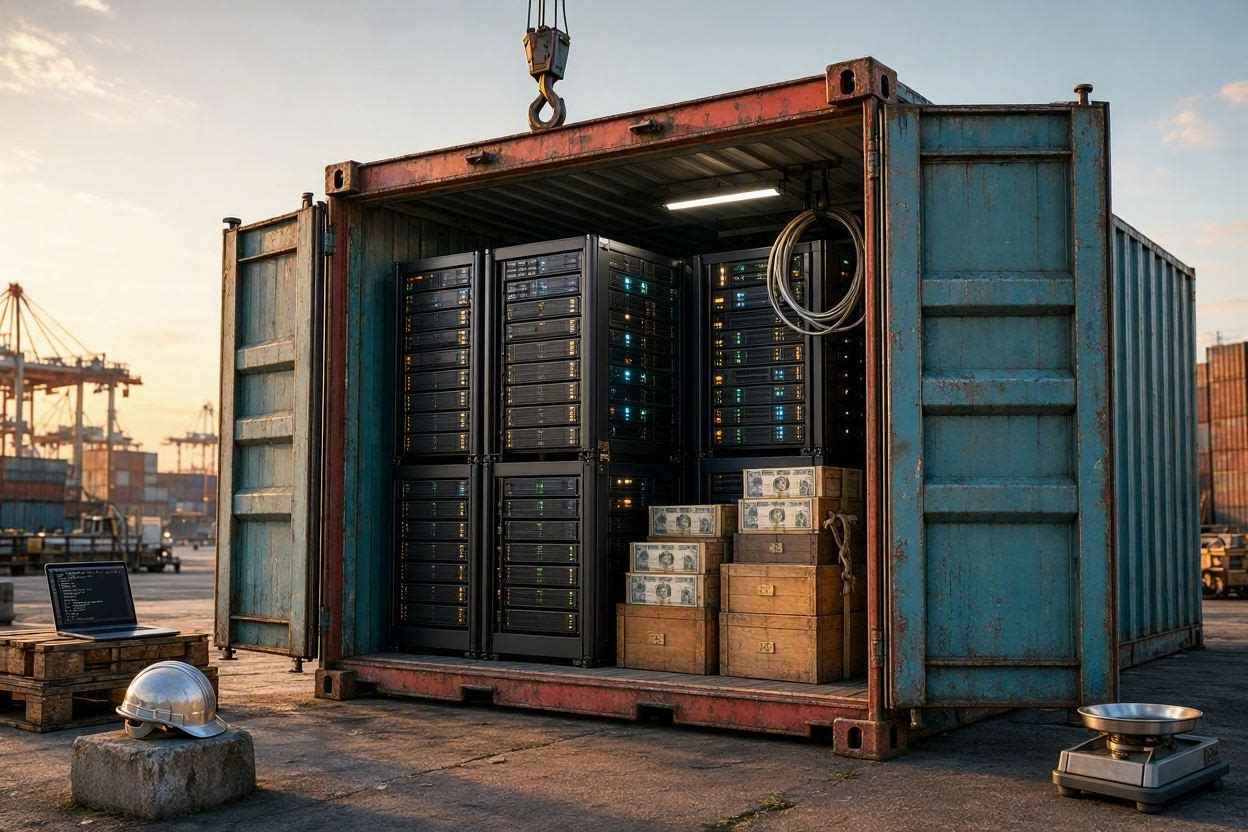
Most shipping containers are pretty boring.
They’re usually designed to haul freight across the ocean, carry goods by rail or store supplies at construction sites.
Nothing particularly exciting about that.
But this one is different.


Image: https://x.com/chadwahl/status/2081444230136803661
It’s not a portable office or a backup generator. It’s not even a small nuclear reactor like the ones I wrote about a few months ago.
But it might have an even greater impact.
Because what’s inside this container might not only change the way companies use artificial intelligence…
It could also create the next wave of winners in the AI infrastructure boom.
An AI Data Center in a Box
So what’s inside the box?
Palantir Technologies (Nasdaq: PLTR) recently teamed up with Nvidia (Nasdaq: NVDA) to unveil what the companies call a Sovereign AI Operating System.
They’ve essentially packed an AI data center into something that can be deployed almost anywhere.
And this isn’t some stripped-down system designed to perform a handful of simple tasks.
Palantir’s reference design includes eight of Nvidia’s Blackwell Ultra GPUs, providing more than 2 terabytes of high-speed GPU memory. It also uses Nvidia’s Spectrum-X networking and can run Palantir’s full AI software stack.
In other words, this is enough computing power to run sophisticated AI models against a company’s own proprietary data without sending every request to a distant cloud provider.
That means a business could run powerful AI from its own headquarters or factories. Hospitals could analyze sensitive patient information. And military bases could deploy mission-critical AI.
Which might not sound all that revolutionary to you.
After all, companies have owned their own computer servers for decades now.
But artificial intelligence has been moving in the opposite direction.
Over the past few years, businesses have largely rented AI from Big Tech. They send their questions and their data to enormous data centers owned by companies like Microsoft (Nasdaq: MSFT), Amazon (Nasdaq: AMZN) and Google (Nasdaq: GOOG).
These data centers have become some of the largest construction projects in history, consuming hundreds of megawatts of electricity and costing tens of billions of dollars to build.
But Palantir is betting that this won’t be the only way companies use AI in the future. And there are plenty of good reasons why they might want AI running closer to home.
Think about an accounting firm. Its customer records might represent decades of accumulated knowledge that needs to remain private.
Or consider a manufacturer with proprietary designs, production schedules and supplier relationships.


It has every incentive to keep that data in-house.
Many businesses are understandably reluctant to send their most valuable information outside their own networks, especially when they’re trusting another company to store, process and potentially build future products around that data.
Running AI locally offers a more secure option because it allows the company to control the hardware and the data.
What’s more, the company gets to decide which AI models to use.
That’s why Palantir calls this Sovereign AI. Because the customer remains in control.
And Palantir isn’t the only company thinking this way.
Other tech companies are expanding their private AI offerings as more businesses look for ways to deploy AI on their own infrastructure instead of relying exclusively on public cloud services.
And servers are only one part of this opportunity.
Every one of these systems also needs memory, storage, high-speed networking, cooling, cybersecurity and a reliable source of electricity.
To me, all of this points to a much larger trend.
A few months ago, I wrote that one of the biggest developments in nuclear energy wasn’t simply that the industry was making a comeback.
It was that nuclear reactors were getting smaller.
Instead of building massive power plants, companies are developing microreactors that can fit inside a shipping container and be deployed where electricity is actually needed.


Image: INL
It seems to me that artificial intelligence could naturally follow a similar path.
The first phase of the AI boom required giant data centers packed with hundreds of thousands of chips. But not every company needs a facility the size of several football fields. Many simply need enough computing power to run AI against their own information.
Sovereign AI allows artificial intelligence to move closer to where the work actually happens.
We’ve seen it happen before. Computing began on expensive mainframes before spreading to businesses and eventually into our homes.
What’s exciting for investors is that each step created entirely new markets.
And I believe that Sovereign AI has the potential to do the same thing.
Here’s My Take
The biggest winners of the AI boom so far have supplied the world’s largest data centers.
Nvidia built the processors, Micron (Nasdaq: MU) supplied the memory and Coherent (NYSE: COHR) helped connect them together.
Strategic Fortunes readers know this well. I recommended all three because I believed AI’s biggest bottleneck would be infrastructure.
And I’m still confident those giant AI factories will continue expanding for years.
But I also believe a second infrastructure boom could be just beginning. And this time, demand might not come from a handful of technology giants.
Instead, it could come from thousands of businesses, hospitals, manufacturers, universities and government agencies bringing AI in-house.
And that could create an entirely new generation of AI infrastructure winners.
Regards,

Ian King
Chief Strategist, Banyan Hill Publishing

Editor’s Note: We’d love to hear from you!
If you want to share your thoughts or suggestions about the Daily Disruptor, or if there are any specific topics you’d like us to cover, just send an email to dailydisruptor@banyanhill.com.
Don’t worry, we won’t reveal your full name in the event we publish a response. So feel free to comment away!