


Three years ago, the biggest names in artificial intelligence were locked in a race to build the smartest chatbot.
Now they’re bringing that race into the physical world.
This month, OpenAI confirmed it’s moving deeper into robotics. Meanwhile, Nvidia recently announced new partnerships with humanoid robot makers, while it continued building out the hardware and software systems designed to power them.
Both of these companies are among the biggest winners of the AI boom.
OpenAI ignited the generative AI revolution, and Nvidia sits at the center of the AI infrastructure buildout.
Yet instead of focusing solely on software, they’re increasingly turning their attention to robotics.
That tells me Silicon Valley has come to an important conclusion.
Teaching a machine to think wasn’t the final destination.
It was merely the first step.
The Next Frontier for AI
Nvidia’s latest robotics announcement wasn’t a robot.
It was something potentially more important.
The company unveiled an open humanoid robot reference design built around its Isaac GR00T software platform and Jetson Thor computing system.
The design combines a humanoid body from Unitree, robotic hands from Sharpa and Nvidia’s own AI hardware and software.

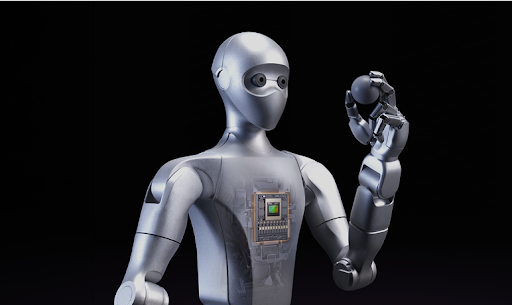
Image: Nvidia
In other words, Nvidia isn’t trying to build the next Tesla Optimus.
It’s trying to become the platform that powers thousands of robots built by other companies.
Because Nvidia didn’t win the AI boom by creating the most popular chatbot. It won by supplying the computing infrastructure that nearly everyone else needed.
And it appears to be pursuing a similar strategy with robotics.
But Nvidia isn’t limiting itself to a single company or country. It also revealed new partnerships with humanoid robot developers across North America, Europe and Asia.
At roughly the same time, OpenAI announced it’s rebuilding its robotics efforts.
OpenAI shut down its robotics division in 2021 because AI models back then simply weren’t capable enough to handle the complexity of operating in the physical world.
Now, the company is once again hiring robotics engineers, actuator specialists and hardware experts. OpenAI has also invested in robotics startups including Figure AI and Norway-based 1X Technologies.
Something has clearly changed.
And I believe the timing isn’t accidental.
Three years ago, humanoid robots had a body problem and an intelligence problem.
The bodies were certainly improving. Companies like Boston Dynamics had already demonstrated machines that could walk, balance and navigate difficult terrain.

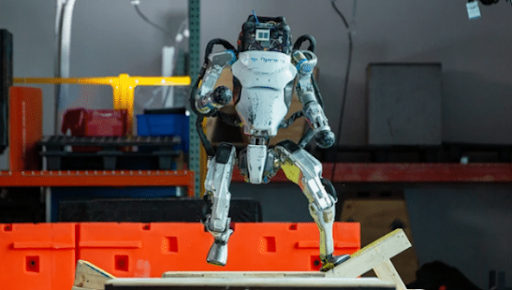
Image: Boston Dynamics
But robots still struggled with the unpredictability of the real world.
And without that ability, they aren’t very useful.
After all, factory workers don’t just repeat the same motion thousands of times. They constantly make small decisions. They adjust when a part is slightly out of place. They recognize when something doesn’t look right. And they respond when conditions change.
Those kinds of decisions have historically been difficult for machines.
Earlier this year, Google DeepMind introduced Gemini Robotics-ER, a system designed to help robots understand physical environments and reason through tasks step by step.
Meanwhile, advances in simulation allow robots to practice tasks millions of times before ever entering a factory. New AI models can interpret images, language and physical surroundings simultaneously. And powerful chips can now run those systems directly on machines operating in the real world.
The result is that robots are becoming more adaptable. Instead of simply following instructions, they’re starting to understand context.
That seems to be the breakthrough that Nvidia and OpenAI have been waiting for.
More Robots, Please
While AI companies were improving robot brains, robotics companies were solving a different problem.
Production.
Figure AI recently announced that its new BotQ manufacturing facility is designed to produce up to 12,000 humanoid robots per year. The company says its production line has already achieved cycle times approaching one robot per hour.
Apptronik raised $520 million earlier this year from investors that include Google and Mercedes-Benz. Its Apollo robots are already being tested inside manufacturing environments, handling logistics and material movement tasks.

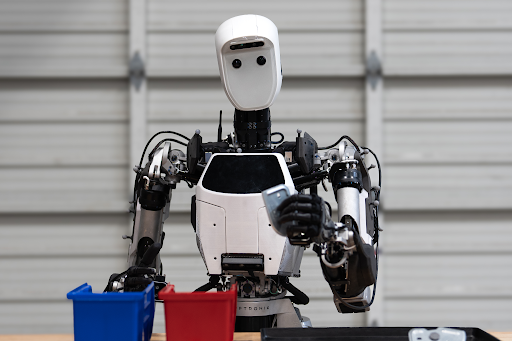
Image: Apptronik
Boston Dynamics is preparing to deploy its electric Atlas robot inside Hyundai facilities, and Tesla continues preparing for larger-scale Optimus production.
Meanwhile, China’s Unitree has already shipped thousands of humanoid robots, making it one of the first companies to move beyond demonstrations and into meaningful production volumes.
None of these companies are talking about teaching robots to walk anymore.
Instead, they’re focused on factories, production lines, deployment schedules and manufacturing capacity.
That means the conversation has shifted from what humanoid robots are capable of…
To how quickly they can be produced.
Here’s My Take
Goldman Sachs estimates that the humanoid robot market could reach $38 billion by 2035.


This explains why Nvidia and OpenAI both appear to be making the same bet.
They realize that the next phase of artificial intelligence won’t remain confined to data centers, chat windows and smartphone screens.
It’ll move into factories, warehouses, hospitals, stores… and eventually into our homes.
The AI boom so far has been all about building machines that can think. But it’s becoming increasingly clear that the next phase will be about building machines that can operate in the physical world.
And robotics could be one of the most important markets of the next decade.
Of course, teaching machines to think was a huge breakthrough.
But now comes an even harder challenge.
Teaching them to work.
Regards,

Ian King
Chief Strategist, Banyan Hill Publishing

Editor’s Note: We’d love to hear from you!
If you want to share your thoughts or suggestions about the Daily Disruptor, or if there are any specific topics you’d like us to cover, just send an email to dailydisruptor@banyanhill.com.
Don’t worry, we won’t reveal your full name in the event we publish a response. So feel free to comment away!