


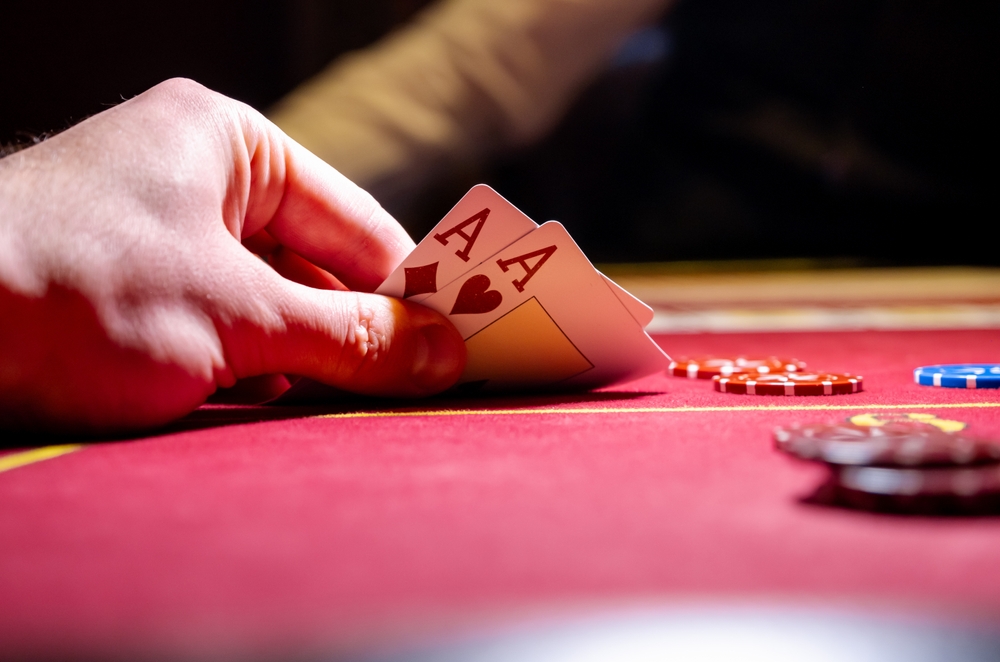
Poker-to-trading pivots aren’t unusual … But does a poker-playing past give traders an edge?
Every one of the traders I told you about yesterday says poker helped speed up their learning curve and achieve the right mindset in trading.
But does that mean that all traders should play poker?
Not necessarily.
Even if you never pick up a deck of cards, a few poker mindset concepts can help any trader.
Here are a few big ones…
#1 Start Small
Dan’s story teaches us that starting too big too fast can cost you. He had to scale back big time to learn the ropes before he got more aggressive.
Don’t think it can’t happen to you.
He says that poker taught him to focus on learning rather than profits. “Experience leads to bigger and better future opportunities.”
Yep, big things have small beginnings!
#2 Risk Management Matters
To be successful in trading, you need a good sense of risk management.
John says as a poker player:
“Every time you decide to put money in the pot, whether it’s betting or raising, you have to calculate ‘pot odds.’
That’s how much you’re putting in the pot compared to the total pot … How much will you win if you win the hand?
You can liken that to the risk/reward ratio in trading.”
Can you be disciplined and cut losses quickly to avoid blowing up your account?
#3 It Takes Time
Just like when playing poker, many people start trading and expect great things to happen right away.
It doesn’t work like that.
Stephen says:
“In the path to playing poker or trading, your first year is about being swung left and right and forward and back.
You don’t know if what you’re doing works, or if you’re just lucky.
You can learn the wrong strategies but get lucky, and that takes you down the wrong path.
That’s why it’s tough.”
Unfortunately, the only solution is time and studying.
Over a few years, you begin to see what works for you. And it’s not just what worked once as a fluke, but what truly works over time.
Do you have the discipline to stick to the rules and trust the process over time?
#4 It’s Not an Exact Science
There are no guarantees in poker … or trading.
John says:
“You make the correct decision … Sometimes you win, and sometimes you lose.
But the important thing is making the correct decision no matter the individual outcome at that specific time.
So poker teaches you to be decision-oriented instead of results-oriented. That translates directly to trading.”
I say it so often: trading is not an exact science.
You could profit 10 times in a row using the same strategy … and it might not work the next time.
It’s not necessarily because you did something wrong. That’s just how it goes in the stock market.
It’s why traders shouldn’t take losses personally — they should try to learn from them.
#5 Find Your Edge
For John, success in poker — and trading — only came after he found an edge.
He says:
“Poker was where I first heard about mathematical edge.
And between poker and card counting at blackjack, I gained a deep understanding of what an ‘edge’ is mathematically, based on statistics and probabilities.
So with trading, once I knew the components that go into having an edge, that made it easier for me to find where I had a verifiable edge.
Then it was easier to trust the edge and have the confidence to put risk on.”
#6 Be Patient
According to John, one of the biggest lessons he learned from poker is when to sit on his hands.
John tells me:
“The best players generally have a tighter range pre-flop … They fold a lot of the hands they’re dealt, like maybe 80%.
And that kind of patience — sitting on your hands, watching the action — can equate to watching stocks moving, seeing all the alerts and chatter in chat rooms, and not letting any of it influence your decisions.”
Dan adds:
“Poker taught me the value of patience, money management, and discipline to make the logical call or fold…
It’s not being results-oriented but rather focusing on the long-term statistical effects.”
Poker + Trading: Process, Not Perfection
Plenty of people come to both poker and trading expecting to get rich quick … And plenty of people fail.
But that’s not the only thing poker and trading have in common. They both require the right mindset, discipline, and hard work.
Are you willing to put in the time to understand trading before you go all in with your hard-earned cash?
If so, it’s important to shift your mindset from profit to process.
Education is the gateway — are you ready to get serious?
Are you a trader who’s played poker in the past? Let me know at SykesDaily@BanyanHill.com … I love hearing from you!
Cheers,

Tim Sykes
Editor, Tim Sykes Daily
