


Last year, I wrote about how your identity could become one of the internet’s most valuable assets.
Now I’m wondering if I was thinking too small.
These days, AI can generate articles, videos and podcasts faster than any person ever could. Which means content creation is becoming abundant.
But when something becomes abundant, something else often becomes scarce. And what’s becoming increasingly scarce on the internet today is trust.
That growing lack of trust is triggering a surprising change in how people navigate the web.
And it may be one of the strangest side effects of the AI boom so far.
The Filter Bottleneck
About a decade ago, an idea floated around online that much of the internet wasn’t being created by humans.
It’s called The Dead Internet Theory. And it gained mainstream attention after a 2021 blog post argued that the web was being filled with bots, fake accounts and automated content.
Back then, a “dead internet” sounded ridiculous to most people.
But today, bots account for roughly 51% of all web traffic.


That means non-human web traffic has now surpassed human web traffic.
Of course, this doesn’t mean that the internet is literally dead. And it doesn’t mean that every comment, article or video you see is fake.
But it does mean the balance has changed.
The web is no longer generated by humans with some automation around the edges. These days, humans, bots, AI crawlers, recommendation systems and content generators all operate together.
And AI has dramatically accelerated the amount of machine-generated content online.
A recent analysis found that AI-generated articles exploded after ChatGPT launched in late 2022. Just one year later, AI was responsible for roughly 39% of newly published articles.
And today, more new articles are generated by AI than humans.


Source: graphite.io
That shift is changing the rules of the internet.
Just five years ago, creating decent content required time and effort. Writing articles and blog posts took real thought, and building websites required technical skill. Even a mere three years ago, producing videos, editing images and recording podcasts still required meaningful effort.
Now all that work can be automated.
A company can generate hundreds of search-optimized pages a day. A spammer can flood review sites with fake feedback. A political operator can test dozens of message variations instantly. And any random website can now publish AI summaries of other AI summaries that still look professional…
Just as long as you don’t dig too deeply.
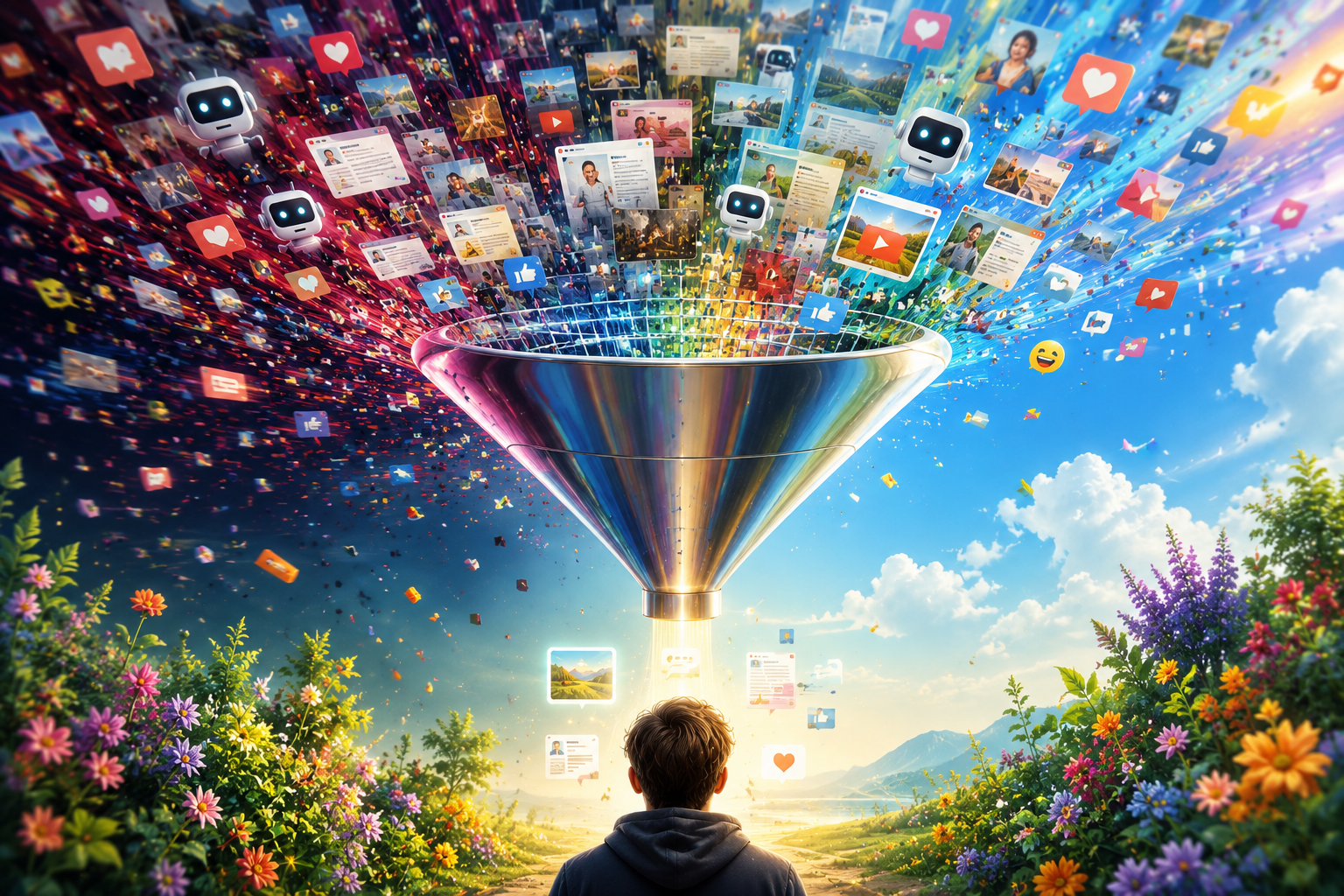
This slog of AI driven content has created what people are calling a “Filter Bottleneck.”
In other words, making more stuff is no longer the hard part. Figuring out what’s worth your attention is.
Decades ago, economist Herbert Simon warned that a “wealth of information creates a poverty of attention.”
AI is proving him right. And it’s forcing companies to react.
Last July, Cloudflare, which helps manage traffic for a huge portion of the internet, began blocking many AI crawlers by default. The company also rolled out a system allowing publishers to charge AI companies for access to their content.
Why?
Because AI companies are scraping enormous amounts of online content. Cloudflare says Googlebot traffic grew 96% over the past year, while OpenAI’s GPTBot crawler rose 305%.


Source: Cloudflare
And that’s changing the economics of content creation.
You see, the internet was built around the idea that publishing more content made you more discoverable.
But AI breaks that bargain.
When an AI system reads your content, summarizes it and answers a user directly, you may never get tagged with a visit. This moves the value away from the page and toward the filter sitting between the user and the internet.
That’s why the idea of a filter bottleneck goes beyond simply dealing with “AI slop.”
AI slop is the visible symptom. It’s the bland article, fake image, recycled LinkedIn post or generic answer you wish to avoid.
But the deeper issue here is trust.
Now that people assume polished content might be machine-generated, they’ve started looking for other signals of authenticity. And it’s making things like specificity, firsthand experience and strong judgment way more valuable.
Even imperfections can be a valuable filter because it suggests a person was actually involved in content creation.
To be clear, I’m not suggesting that creators should intentionally make their work worse. All that would do is create a different kind of slop.
But with so much artificial content being created every day, it’s becoming a lot harder to stand out online.
And that’s making smaller online communities more valuable. These days, a private Discord channel, a niche newsletter from a trusted analyst, or a good Reddit thread can feel more useful than a search page full of polished summaries.
Not because those spaces are necessarily more useful than AI, but because they feel more human.
Here’s My Take
I still believe that online verification is going to become a major digital asset.
But verification alone may not be enough anymore.
A verified human can still publish lazy AI content. And a verified company can still flood the internet with low-value pages.
Today, people aren’t just looking for proof that what they’re seeing online was made by someone real. They’re looking for proof that someone actually thought about what they’re saying.
Which means a point of view will become a lot more valuable in the years ahead.
As always, I want to hear yours.
If you care to share your thoughts or suggestions about the Daily Disruptor, or if there are any specific topics you’d like us to cover, just send an email to dailydisruptor@banyanhill.com.
We won’t reveal your full name in the event we publish a response.
And I read through every email that comes my way!
Regards,

Ian King
Chief Strategist, Banyan Hill Publishing
