


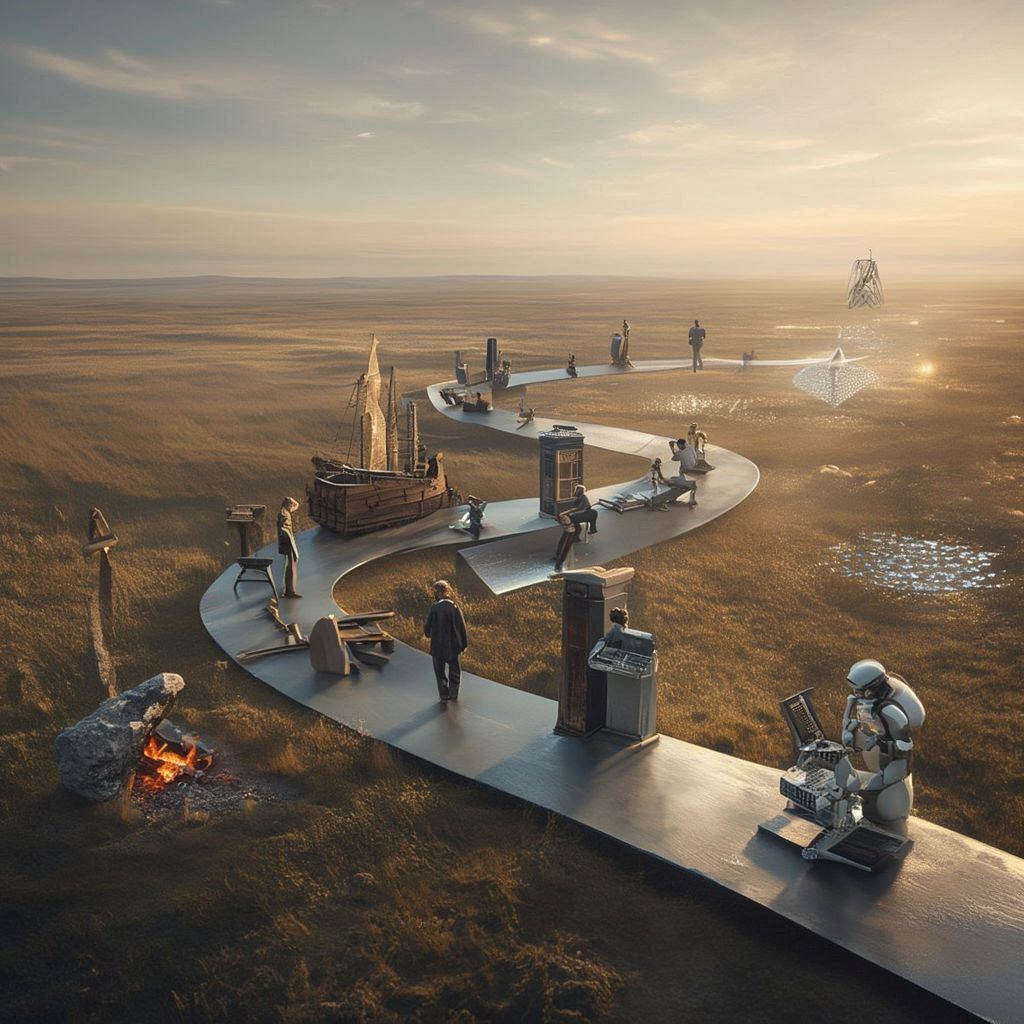
If the news lately feels a little surreal, you’re not imagining it.
In a single week, we saw living human neurons play the video game Doom, a fruit fly brain run inside a digital simulation and AI systems operate computers like human workers.
A decade ago, any one of those stories might have dominated the headlines for weeks.
Now they seem almost trivial.
In fact, the pace of discovery is speeding up so quickly, breakthroughs that once would have shocked the world barely register anymore.
This week’s chart helps explain why.
An Exploding Timeline
This week’s chart comes from researcher Max Roser at Our World in Data. And it attempts to do something extremely ambitious.
It maps the entire history of human technology.
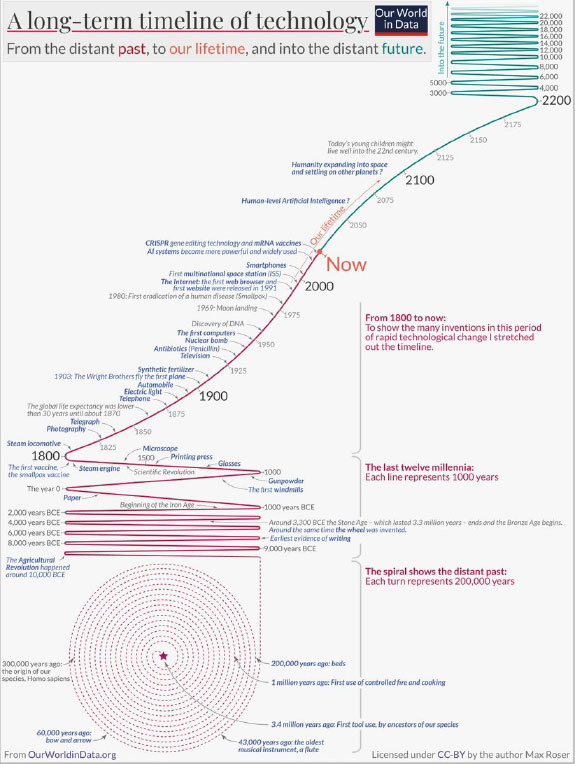

As you can see, it reveals a powerful pattern.
For most of human history, technological progress was painfully slow.
The spiral at the bottom of the chart represents deep prehistory. Each turn covers about 200,000 years. During those vast stretches of time, change was minimal.
The first stone tools appeared roughly 3.4 million years ago. Early humans learned to control fire about a million years ago. And simple musical instruments showed up tens of thousands of years ago.
These were enormous breakthroughs for our ancestors. But they were separated by hundreds of thousands of years.
Even after agriculture appeared around 10,000 BCE, progress still moved slowly.
The wheel, writing and gunpowder were all innovations that transformed societies, yet centuries often passed between major breakthroughs.
Then something changed.
As you can see, around the year 1800 the line on the chart begins to curve upward.
That’s when the Industrial Revolution started rewiring the world.
Steam engines appeared and railroads spread across continents. Soon electricity arrived, and the telephone followed, connecting distant cities.
And by the early 1900s, inventions started stacking on top of one another.
Automobiles. Airplanes. Antibiotics. Nuclear power. Computers.
Then the curve steepened again.
The internet launched in the early 1990s. Smartphones followed in the 2000s. Today, artificial intelligence systems are improving at a pace that even surprises the people building them.
In other words, the closer we get to the present, the shorter the gap between breakthroughs becomes.
What once took centuries now happens in decades.
What once took decades now happens in years.
And sometimes, as we’ve seen recently, multiple breakthroughs can happen in the same week.
This chart also hints at what could come next.
The far right side projects possible milestones for the coming decades. These include human-level AI and the possibility of humans expanding deeper into space.
Of course, those projections are speculative. No one really knows when these technologies might become practical.
But this chart clearly shows us that technological progress doesn’t move at a steady pace.
It keeps accelerating.
Here’s My Take
If you feel like the world’s changing faster than ever, you’re not crazy.
As this week’s chart proves, it’s a very real phenomenon.
For most of human history, innovation has inched forward. Entire civilizations lived and died with very little technological change.
Then the Industrial Revolution kicked off a chain reaction, and each generation of technology made it easier to create the next one.
That feedback loop is why the curve on this chart keeps bending upward.
George Gilder and I call this moment Convergence X. It’s an incredibly exciting period when advances in fields like AI, biotechnology and computing accelerate each other.
And it’s why today’s headlines can feel almost unbelievable.
Because these breakthroughs will continue to reinforce one another, and the pace of change will keep speeding up.
Regards,

Ian King
Chief Strategist, Banyan Hill Publishing

Editor’s Note: We’d love to hear from you!
If you want to share your thoughts or suggestions about the Daily Disruptor, or if there are any specific topics you’d like us to cover, just send an email to dailydisruptor@banyanhill.com.
Don’t worry, we won’t reveal your full name in the event we publish a response. So feel free to comment away!