


In 2006, six healthy men volunteered to test an experimental drug called TGN1412.
Before the trial, researchers had tested the drug on monkeys at doses up to 500X larger than the dose planned for humans.
And the lab animals showed no serious problems.
But within minutes of receiving the drug, all six men suffered a catastrophic immune reaction. Their organs began to fail, and some required intensive care for months.


The animal tests had done what they were designed to do, but they still hadn’t predicted what would happen inside a human body.
And the results were nearly deadly.
Today, the FDA is finally rethinking how we decide when a new drug is safe enough to test on people.
A Better Way of Testing
TGN1412 is an extreme example of a much larger problem.
Mice, monkeys and humans share a great deal of biology. That’s why animals have played such an important role in medical research.
But we aren’t identical.


Different species can absorb and break down the same drug in different ways. Their immune systems can also produce very different reactions.
So a medicine that appears safe in a mouse or monkey can behave differently inside of humans.
According to the FDA, more than 90% of drugs that appear safe in animal studies never receive approval. Most fail because of safety problems or because they don’t work as expected in people.
That doesn’t mean animal testing is useless. It has helped scientists develop lifesaving medicines and stopped countless dangerous compounds from reaching people.
But it remains an imperfect stand-in for human biology.
What’s more, those imperfections are enormously expensive.
Developing a new drug can take more than a decade and cost billions of dollars. And the later a medicine fails, the more time and money its developer loses.
That’s why one of AI’s most valuable roles in medicine could be helping bad drugs fail sooner.
The federal government is now taking steps to make that possible.
In 2022, Congress changed federal law to clarify that drug companies could use non-animal methods to support applications to begin human trials. Then, in April 2025, the FDA released a formal roadmap for reducing animal testing.
The agency began with monoclonal antibodies, a major class of medicines used to treat cancer, autoimmune diseases and other conditions.
Developing one of these drugs can require as many as 144 monkeys. The FDA estimates that each animal can cost up to $50,000.
But under new draft guidance, some six-month primate studies can now be shortened to three months. And in certain cases, they could be eliminated completely.


And the FDA isn’t simply removing animal tests. It wants to replace them with tools that may provide a clearer picture of what happens inside people.
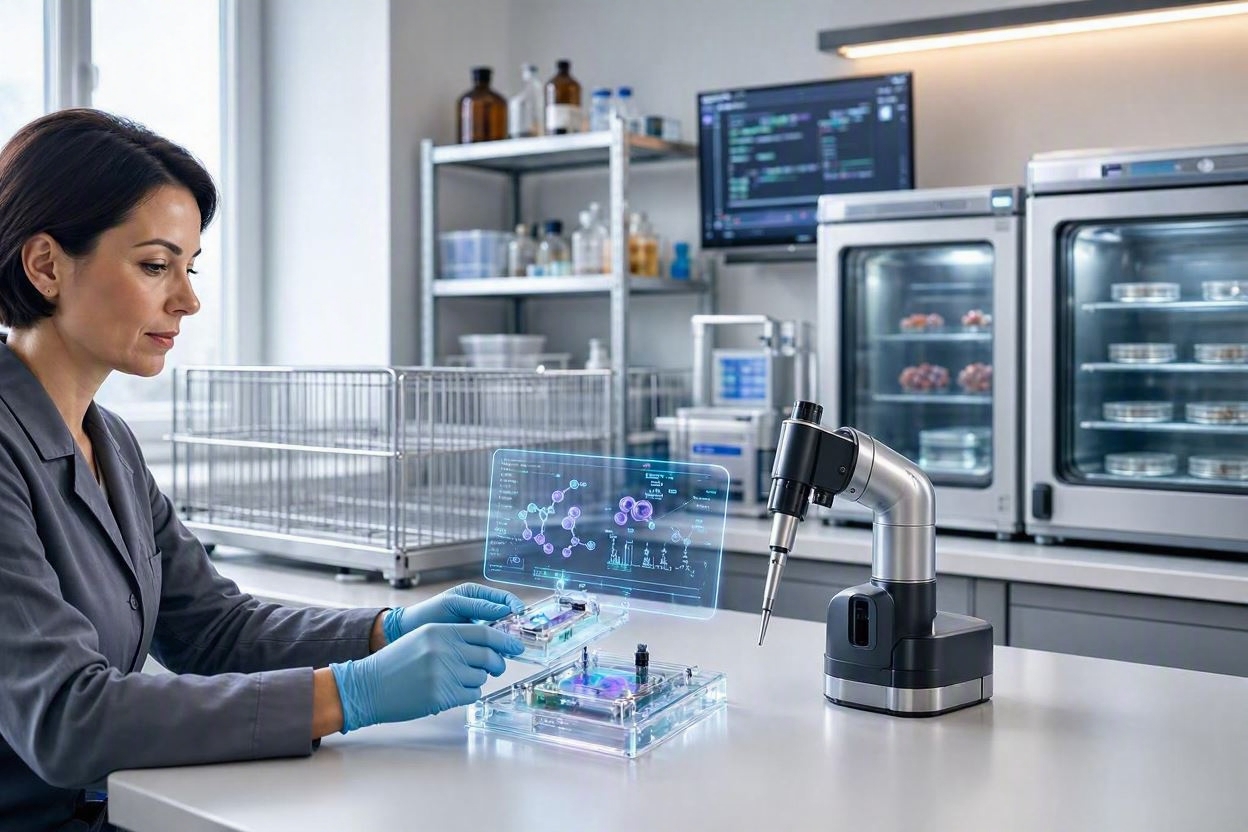
These tools are known as new approach methodologies, or NAMs. They include AI simulations, lab-grown human tissue, organoids and organs-on-chips.
An organoid is a tiny cluster of human cells grown to act like part of a liver, heart or other organ.
An organ-on-a-chip is even stranger.


Image: Emulate Inc.
Living human cells are placed inside a small device with channels that mimic blood flow, pressure and movement inside the body. In other words, it adds something like plumbing.
Researchers can give this miniature organ an experimental drug and watch how it reacts. AI can then analyze the results and combine them with chemical data, genetic information and clinical records.
It’s like a crash-test system for medicine. And there are early signs that it works.
Researchers tested 870 human Liver-Chips against 27 drugs whose effects were already known. The chips identified 87% of the drugs known to cause liver damage and also correctly cleared every drug in the test that was known not to harm the liver.
Another system called ToxPredictor uses AI to study how human liver cells react to different compounds.
Researchers trained it on 300 drugs tested at several concentrations. In a blind test, it detected 29 of 33 drugs known to cause liver damage without producing a false alarm among the 14 safe drugs.
More impressively, ToxPredictor identified liver risks in three drugs that later failed during Phase III human trials.
Traditional preclinical testing had missed those dangers.
Of course, these systems aren’t ready to replace every animal study, but they might already detect certain risks that animals can’t. That could save years of work and millions of dollars, and it could also protect volunteers from dangers that animal studies failed to catch.
For now, these tools will complement animal testing.
But at least the FDA is finally asking whether a better test exists.
Here’s My Take
Drug development is filled with expensive failures. Companies can spend years and hundreds of millions of dollars on a promising treatment before discovering that it’s unsafe or simply doesn’t work in humans.
AI doesn’t need to discover the next miracle drug to transform this process.
It could create enormous value simply by identifying failures sooner. This would also allow drugmakers to stop spending money on dead ends and devote more resources to treatments with a better chance of reaching patients.
That makes this partly an animal-welfare story.
But human trials could also become much safer if AI is able to catch dangers that testing on mice and monkeys sometimes misses.
And this is only scratching the surface of AI’s potential impact on the economics of medicine.
In our next issue, I’ll show you why the lab animal of the future might not be an animal at all.
Regards,

Ian King
Chief Strategist, Banyan Hill Publishing

Editor’s Note: We’d love to hear from you!
If you want to share your thoughts or suggestions about the Daily Disruptor, or if there are any specific topics you’d like us to cover, just send an email to dailydisruptor@banyanhill.com.
Don’t worry, we won’t reveal your full name in the event we publish a response. So feel free to comment away!