


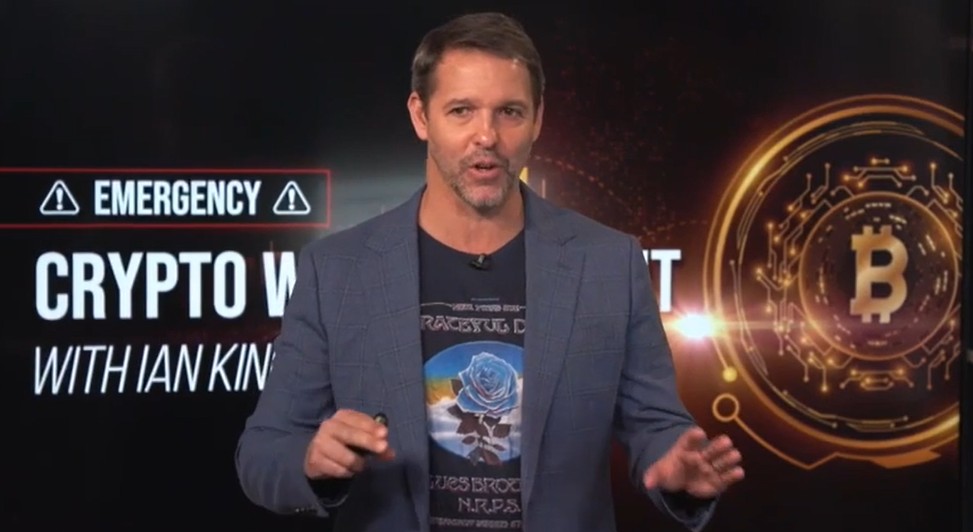
I had a great time connecting with folks during yesterday’s Emergency Crypto Winter Summit.


We talked through what’s shaping today’s crypto market, which still sits near a $2 trillion valuation and has far more infrastructure and participation than in earlier cycles.
If you joined us, you also heard me talk about how large financial firms continue to invest in digital assets, tokenization and market infrastructure even while bitcoin has fallen back toward levels last seen in 2024.
That tells you serious money is still being committed to this space, despite crypto sentiment souring recently.
This week gave us a clear real-world example of that gap between short-term mood and long-term strategy.
Because crypto investors were pulling back while the world’s largest asset manager was wiring traditional assets into DeFi rails.
Big Money Isn’t Leaving Crypto
BlackRock, which manages more than $12.5 trillion in assets, said this week that its tokenized Treasury fund known as BUIDL can now trade through infrastructure tied to Uniswap.
BUIDL is basically a digital version of a conservative bond fund that was launched in 2024 and is now valued at roughly $2 billion. It holds short-term U.S. government debt and cash, and investors earn income from those holdings the same way they would in a traditional fixed-income product.
The difference is how ownership is tracked.
Instead of shares sitting inside brokerage accounts and clearing networks, investors hold blockchain tokens that represent their stake. These tokens can now be bought and sold using decentralized trading systems rather than relying entirely on traditional middlemen.
Because Uniswap isn’t a stock exchange.


It’s software that runs on a blockchain.
Uniswap allows assets to trade through shared pools of capital supplied by participants. When someone wants to buy or sell, those pools provide the other side of the trade. The software sets prices and completes transactions automatically, and people who supply capital earn a portion of the trading fees.
This is what keeps activity flowing.
But access to this setup isn’t open to the public. Only large, approved investors can trade BUIDL this way. Professional trading firms commit capital on both sides of the market so transactions can happen without big price swings.
And it’s worth remembering that bitcoin still sits at the center of this ecosystem. It remains the primary benchmark asset and institutional entry point into the space.
That’s why I said yesterday that short-term volatility doesn’t change bitcoin’s structural role in the market.
So why did BlackRock make this move now?
It has nothing to do with retail crypto speculation. Instead, it’s a test of whether blockchain systems can handle real financial assets at scale.
In other words, it’s a test of the plumbing that keeps markets running.
Traditional trades move through middlemen and can take days to settle. But blockchain systems handle matching and ownership directly with software, which can drastically speed things up.
Think about sending money overseas 20 years ago compared with how instant digital payments work today. That’s the type of efficiency experiment underway here.
Roughly $100 billion already sits in DeFi liquidity pools, and large institutions are exploring whether those systems can improve how traditional assets trade and settle.
BlackRock isn’t migrating markets yet.


The company is simply testing whether some of the core functions behind traditional markets can run on these newer blockchain rails.
But the timing lines up perfectly with what I wrote about on Wednesday and what I talked about yesterday.
Major infrastructure advances in crypto rarely coincide with peak enthusiasm. They tend to happen during rough patches like this, when most people are focused on falling prices.
After the 2018 crash, decentralized lending began gaining traction.
After the 2020 shock, tools for institutional custody expanded.
And following the 2022 downturn, tokenization efforts accelerated.
During all of those downturns, development kept moving forward even as the mood turned negative. That’s because retail investors often react to volatility, while institutions tend to look further ahead
That doesn’t mean the big money ignores price swings. But institutional investors also weigh where the market might be heading.
A recent Coinbase survey highlights this divide. Even after bitcoin fell from above $125,000 in October 2025 to around $90,000 by year-end, roughly 70% of institutional investors still viewed it as undervalued, compared to about 60% of non-institutional investors who agreed.
That helps explain what’s happening right now. Many investors are reacting to volatility, but financial institutions are focused on where the technology is headed over the long run.
Short-term price swings don’t change that trajectory.
Here’s My Take
While media coverage has focused on fears of potential “crypto winter,” the world’s largest asset manager was busy testing blockchain trading systems.
BlackRock’s latest move reinforces something I keep coming back to…
Market sentiment and capital don’t always move together.
Even though crypto sentiment has soured recently, major financial firms continue to invest in blockchain infrastructure. That tells me the technology is being evaluated as a long-term tool, not a short-term trade.
I’ve seen this same dynamic play out across previous cycles. It has been consistent enough that I factor it into how I read the market.
And there’s another pattern that tends to form when fear peaks. I’ve seen it three times in my career, and each time it led to some of my biggest gains.
That same setup is forming again today.
I walked through it during yesterday’s live briefing, and I also talked about three tiny coins I’ve identified with the potential for 1,000% gains once bitcoin takes off again.
If you weren’t able to make it yesterday, I have good news.
We’ve posted a limited rebroadcast online.
Click here to watch a replay of the Emergency Crypto Winter Summit.
Before this exciting moment passes by.
Regards,

Ian King
Chief Strategist, Banyan Hill Publishing

Editor’s Note: We’d love to hear from you!
If you want to share your thoughts or suggestions about the Daily Disruptor, or if there are any specific topics you’d like us to cover, just send an email to dailydisruptor@banyanhill.com.
Don’t worry, we won’t reveal your full name in the event we publish a response. So feel free to comment away!
Learn more about Ian King Next Gen Coin here.