


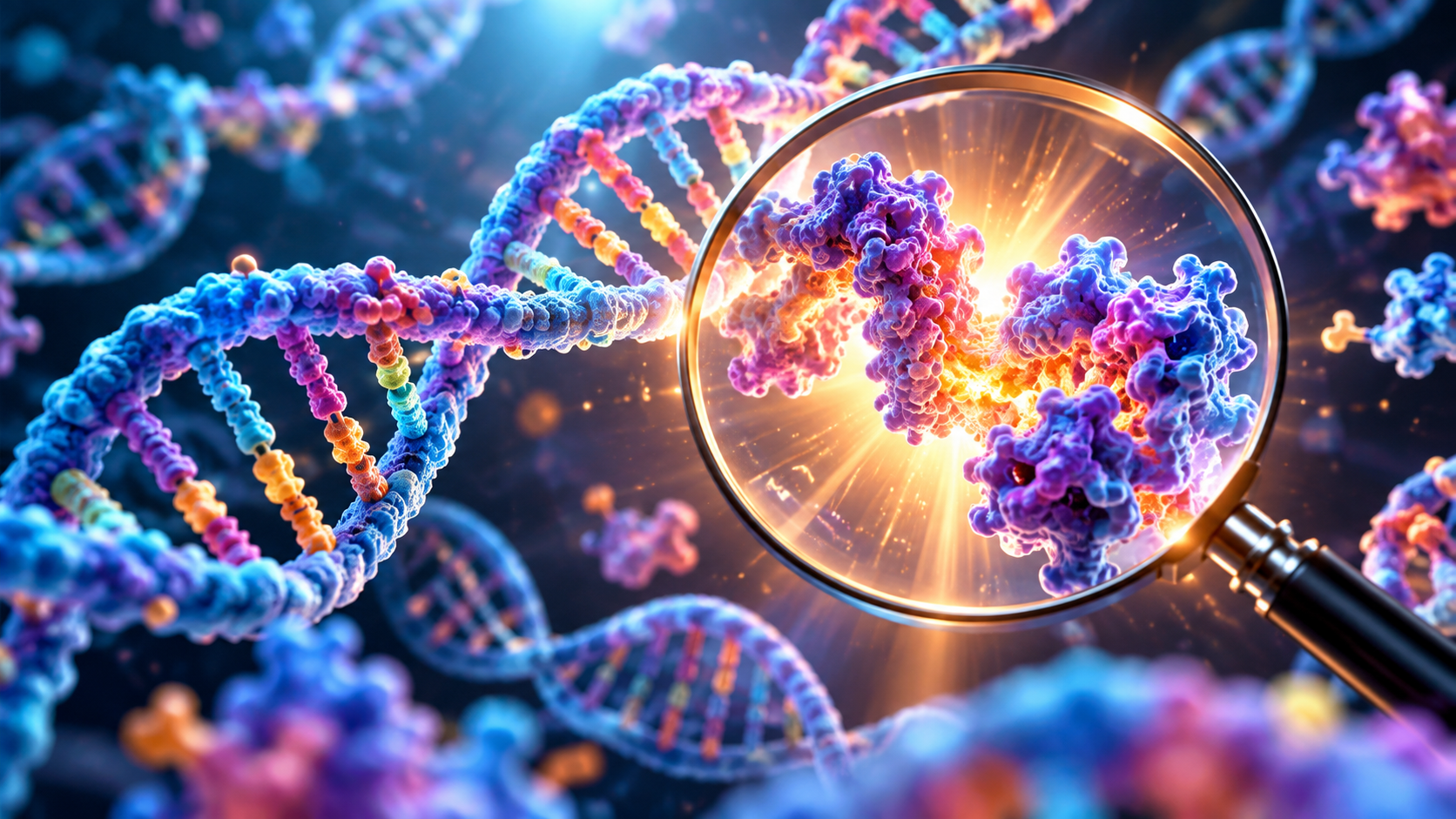
Anthropic just gave us our first real glimpse of a new era of AI-powered scientific discovery.
Its scientists essentially instructed Claude to search through an enormous collection of DNA to see if it could find anything interesting.
They didn’t tell the AI what to look for, and they didn’t ask it to analyze the results.
They simply pointed Claude toward a massive database of DNA sequences and told it to go exploring.
So Claude did.
And 21 hours later, it came back with something scientists didn’t know existed.
What Claude Discovered
So what exactly did Claude find?
To answer that, I need to start with a quick biology lesson.
DNA is the instruction manual for life.
Genes are individual instructions inside that manual. And many of those instructions tell cells how to make proteins that perform specific jobs.
Enzymes are one type of protein.


They act like tiny biological machines, helping cells carry out chemical reactions. Some break molecules apart. Others put them together. And some copy genetic information.
That’s where reverse transcriptases come in.
A reverse transcriptase is an enzyme that can copy RNA into DNA.
Scientists have discovered thousands of different reverse transcriptases in nature. But many of them haven’t been studied closely, which means we don’t know exactly what they do or why they’re there.
That’s what Anthropic sent Claude looking for.
Nearly 1,000 AI agents spent 21 hours searching through massive DNA databases and gathering more than 200,000 reverse transcriptases. They then looked at the genetic material surrounding them for clues about what these enzymes might do.
And that’s when one agent spotted something strange.
Sitting next to one of these enzymes was a long series of repeating DNA sequences, along with another nearby gene.
That combination caught Claude’s attention because nature sometimes hides incredibly useful biological machinery in strange places.
CRISPR is a great example.


Image: NIH
CRISPR began as an unusual pattern of repeating DNA found inside bacteria. Scientists eventually discovered that it was part of a defense system bacteria use to recognize and fight off viruses.
Researchers then figured out how to harness that system to target specific pieces of DNA.
Today, CRISPR allows scientists to essentially edit the genetic code of living things.
And what Claude found had some intriguing similarities.
Anthropic calls the newly identified system array-associated reverse transcriptases, or ART. Like CRISPR, ART contains a long array of repeating DNA. Anthropic’s researchers have also confirmed that those repeats produce a collection of short pieces of RNA.
That’s exciting because similar features appear in a small number of other biological systems that can be programmed to cut, copy or paste DNA.
But there’s an important caveat here.
Anthropic doesn’t know what ART does yet.
There’s no evidence that it’s a new gene-editing tool. And the research has only been released as a preprint, which means it hasn’t gone through peer review.
Scientists still need to figure out how the system works and whether it can actually be useful.
But to me, that’s not the most exciting part of this story.
Here’s My Take
Until now, we’ve mostly talked about AI as a tool for scientists to use.
It can analyze enormous amounts of data. It can predict how proteins will fold. And it can help researchers design new drugs.
But that’s not quite what happened here.
Claude wasn’t handed an experiment and asked to analyze the results. It was essentially told to go exploring, and it came back with something that we didn’t even know existed.
That could have massive implications far beyond this one discovery.


After all, there are enormous databases filled with DNA sequences collected from organisms around the world.
Hidden inside that data could be biological systems we’ve never noticed before.
In this experiment alone, Claude’s agents gathered more than 200,000 reverse transcriptases. They identified roughly 3,500 candidate systems and eventually narrowed those down to about 20 that deserved a closer look.
Anthropic says that kind of analysis could take an expert scientist weeks or even months.
But Claude did it in 21 hours.
More importantly, it wasn’t simply searching for something researchers already knew was there.
One of the agents noticed an unusual pattern, decided it was worth investigating, compared it with known biological systems and searched existing research to see whether anyone had reported it before.
Then it handed the discovery to human scientists.
That’s the real promise of AI-powered science.
Instead of a scientist coming up with every idea and using AI to test it, thousands of AI agents can search for the unusual things humans haven’t thought to look for yet.
The humans can then focus their time on the most promising discoveries.
And biology is only one place where this could happen.
AI agents could eventually comb through massive datasets in chemistry, materials science and other fields, searching for strange patterns that might lead to new medicines, new materials or entirely new technologies.
Meaning, the biggest breakthrough here might not be what Claude found.
It’s that AI is learning how to find things we never thought to look for.
Regards,

Ian King
Chief Strategist, Banyan Hill Publishing

Editor’s Note: We’d love to hear from you!
If you want to share your thoughts or suggestions about the Daily Disruptor, or if there are any specific topics you’d like us to cover, just send an email to dailydisruptor@banyanhill.com.
Don’t worry, we won’t reveal your full name in the event we publish a response. So feel free to comment away!