


On June 19, 1865, Union troops arrived in Galveston, Texas, and informed enslaved people that they were free.
The moment became known as Juneteenth.
But historians still debate countless details about what happened during that period of American history.
Not because the records don’t exist. But because many of them are still buried in archives, libraries, courthouses and storage rooms across the country.
In fact, much of human history remains surprisingly difficult to access.
Millions of handwritten documents, newspapers, letters and government records have never been fully digitized. And even when they have been scanned, the information often remains trapped inside images that computers cannot easily search or understand.
For generations, uncovering those records required historians to spend years digging through boxes and filing cabinets.
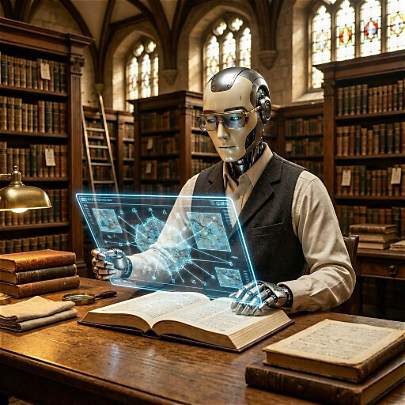
Artificial intelligence may be about to change that.
History’s Filing Cabinet
For most of the digital age, preserving history has been relatively simple.
You scanned or photographed a document, then you uploaded that image to a database and moved on.


The problem is that a scanned document isn’t the same thing as a searchable document.
Imagine taking a picture of every book in a library. Sure, you’d have preserved the information. But finding a specific sentence would still require someone to sit down and read through all of it.
That’s the challenge historians have faced for decades.
Libraries, museums and archives have spent years digitizing millions of records. Yet much of that information has remained effectively hidden because computers couldn’t reliably read faded ink, unusual handwriting or centuries-old scripts.
That’s beginning to change.
Recent advances in handwriting recognition allow AI systems to read many historical documents that traditional software struggles to decipher. Researchers are now using these tools to transcribe letters, government records, newspapers and manuscripts that previously required enormous amounts of manual labor to process.
And the scale is enormous.
The Library of Congress has spent years digitizing historical collections, including millions of pages of newspapers through its Chronicling America project.


Image: Carol M. Highsmith
Today, machine learning tools help make those collections searchable in ways that weren’t possible just a few years ago.
One project alone analyzed more than 16 million historic newspaper pages using AI-powered image recognition.
And genealogy researchers are seeing the same kind of transformation.
FamilySearch recently launched a system that uses AI to read and interpret historical records that had never been indexed. The tool can search nearly 2 billion previously difficult-to-access records, helping researchers locate names, places and events that once required countless hours of manual searching.
The organization added more than 2.2 billion new searchable names and images in 2025 alone.
Government archives are moving in the same direction.
The National Archives is now experimenting with AI systems that automatically generate descriptions, summaries and metadata for digital records.


Image David Samuel
The goal is to help process massive backlogs and make millions of documents searchable much faster than human archivists could manage on their own.
And this trend extends far beyond the United States.
Researchers recently began using AI to analyze the Cairo Geniza, one of the world’s largest collections of medieval manuscripts. More than 400,000 documents have been preserved for centuries, but only a small fraction were fully transcribed.
AI is now helping scholars read, organize and connect records that would have taken generations to process manually.
What’s fascinating about all of this is that AI isn’t creating anything new.
It’s simply helping us access information that was already there.
Here’s My Take
Ever since the Library of Alexandria, humanity has worried about losing knowledge.
Today, the challenge is finding it.
But AI may finally be giving us a way to solve this problem.
And it begins reading through humanity’s forgotten records, it could help us see the past with a clarity that previous generations could only dream of.
Regards,

Ian King
Chief Strategist, Banyan Hill Publishing

Editor’s Note: We’d love to hear from you!
If you want to share your thoughts or suggestions about the Daily Disruptor, or if there are any specific topics you’d like us to cover, just send an email to dailydisruptor@banyanhill.com.
Don’t worry, we won’t reveal your full name in the event we publish a response. So feel free to comment away!