


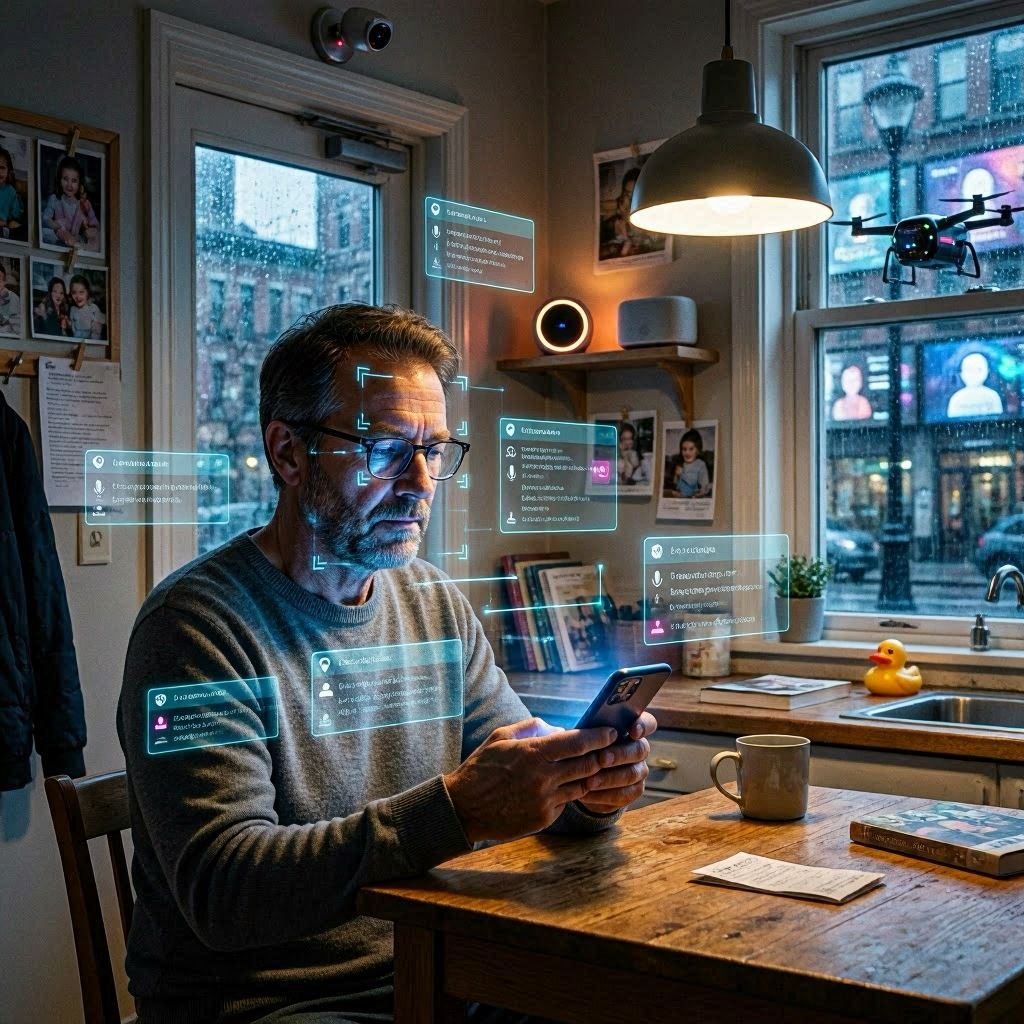
In our last issue, I talked about how researchers recently found that ordinary Wi-Fi routers could identify individuals with 99.5% accuracy.
But that shocking revelation only hints at a much bigger privacy concern.
Cities around the world are beginning to fill themselves with connected technology designed to make daily life run more smoothly.
We call them “smart cities.”
Places where traffic lights adjust automatically, sensors reduce congestion and connected streets help emergency responders react faster. Some systems can even direct drivers to the nearest open parking spot before they start circling the block.
But all this tech-driven convenience is creating an entirely new challenge:
Who owns all the information these systems create?
AI is changing the answer.
And as it becomes even more powerful, privacy could soon mean something very different than it does today.
The Privacy Problem Comes to Town
One of the most famous smart city experiments started in Toronto.
In 2017, Sidewalk Labs, a sister company to Google, announced plans to help build a futuristic neighborhood along the city’s waterfront.


Image: Waterfront Toronto
The idea was to use sensors, connected infrastructure and data to make urban life cleaner, safer and more efficient.
On paper, it sounded like exactly the kind of project cities should want. It promised less traffic, lower energy use, better public transit and more efficient buildings.
But the project quickly ran into a problem that had nothing to do with whether the technology worked.
Instead, people wanted to know what would happen to all the data these systems collected. Ann Cavoukian, Ontario’s former privacy commissioner, even resigned as a consultant after raising concerns that the project wouldn’t require data to be de-identified at the source.
That concern eventually helped derail the project.
That concern eventually helped derail the project.
And it highlights something investors should pay attention to.
Building smarter cities is hard. Building them while protecting privacy may be even harder.
If a city can collect data from traffic cameras, parking sensors, public Wi-Fi, streetlights and connected buildings, then privacy has to be built into the system from the beginning.
Depending on the estimate, the global smart cities market is already approaching $1 trillion. And it could grow dramatically over the next decade.
Some estimates project smart city growth to reach as high as $3.8 trillion by 2030.


Image: grandviewresearch.com
But cities are already spending serious money to become more connected, more automated and more data-driven.
And I’m not saying that’s a bad thing.
A city that understands traffic flow can reduce congestion. A city that monitors water systems can catch leaks before they become disasters. A city that tracks energy use can lower waste. And a city that uses sensors to monitor bridges, roads and public infrastructure can spot problems before they become dangerous.
That’s the promise of smart cities.
But AI adds a new layer of complication. Because older systems mostly collected information.
AI can interpret it. And that makes a huge difference.
A camera used to simply record video. Now AI can scan that video for license plates, faces, movement patterns or unusual behavior.
A traffic sensor used to count cars. Now AI can connect thousands of individual observations into a detailed map of how people travel, work and live.
A connected building used to track energy use. Now AI can learn when people arrive, where they gather and how they move through the space.
In other words, AI doesn’t just help cities collect more data. It helps them turn ordinary activity into information.
And that’s increasingly becoming a privacy concern.
Flock Safety, a company that makes automated license plate reader cameras, is one of the most visible examples. Its cameras are designed to help police identify stolen vehicles, wanted suspects and cars connected to crimes.


Image: Sumner Police Department Facebook page
Obviously, that sounds like a good thing at first blush. But across the country, some communities are pushing back on implementing these systems.
California cities including Mountain View and South Pasadena have paused or shut down Flock systems amid concerns regarding misuse, immigration enforcement and public trust.
In Bandera, Texas, a town of about 900 people, the city council recently voted to terminate its Flock contract after months of privacy concerns and public opposition.
And at least 53 other jurisdictions across 20 states have discontinued similar AI-driven surveillance systems in recent months.
That proves the privacy debate isn’t only happening in big cities filled with activists and tech lawyers.
It’s happening in small towns too.
I’ve been watching this trend for years.
Back in 2019, I recommended Verra Mobility (Nasdaq: VRRM) to my Strategic Fortunes readers. The company helps build and operate the connected transportation networks that are becoming a key part of smarter cities. We eventually exited the position with a gain of around 24%.
Today, AI is building on top of that same infrastructure.
And I believe the opportunities this creates could be much bigger.
Here’s My Take
Smart cities create information in the background.
When you drive past a camera or walk through a train station or enter a building filled with sensors, you may not even be aware that you’re sharing anything.
But the system is still learning from you.
As cities continue filling themselves with connected infrastructure, sensors and intelligent systems, privacy may no longer just be about protecting the information we intentionally share.
It may become about protecting our information from the environment around us.
And solving that problem may create one of the fastest-growing new technology markets in the world.
In our next issue, I’ll show you just how big that opportunity could become.
Regards,

Ian King
Chief Strategist, Banyan Hill Publishing
